
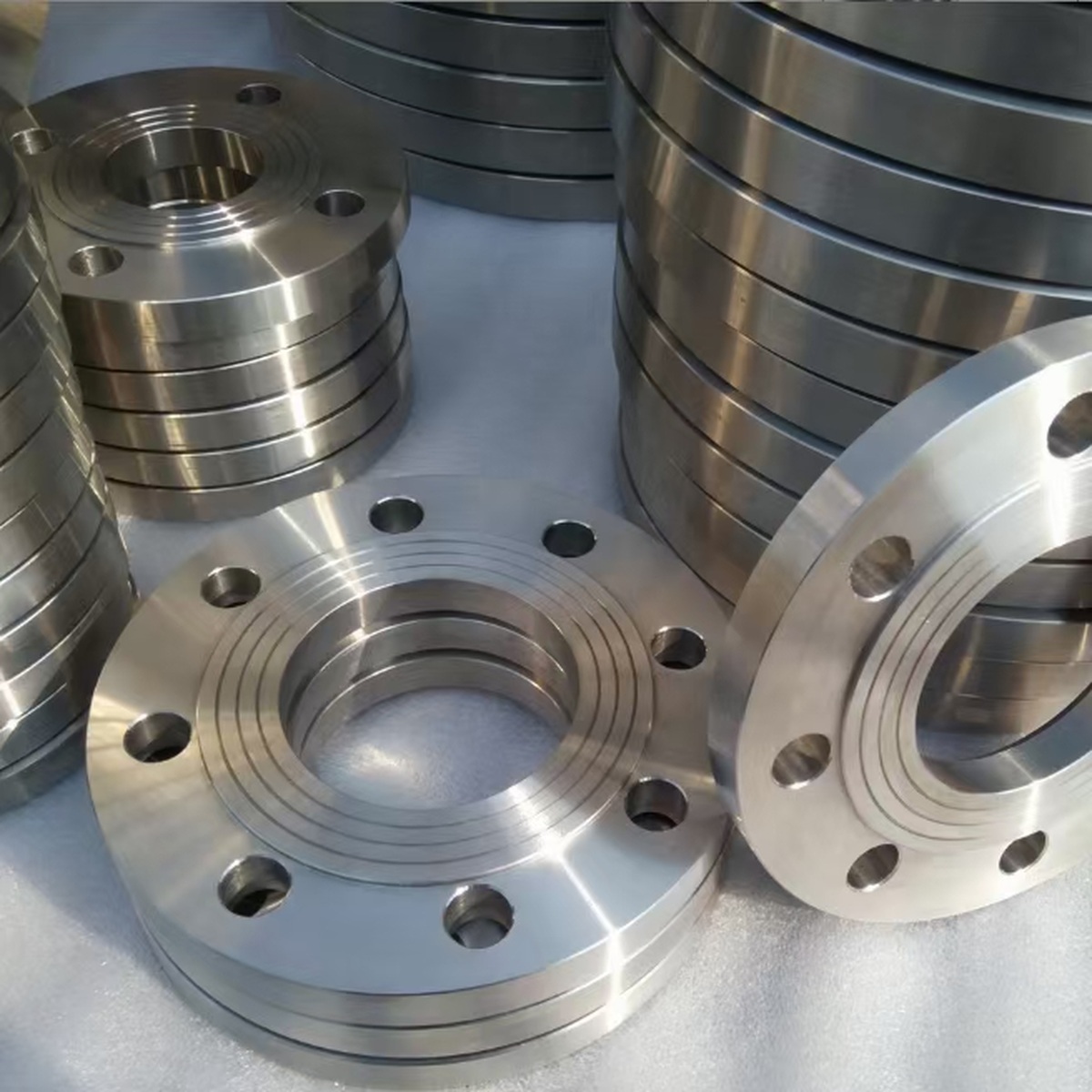
Titanium flanges are precision connection components used in piping, equipment, vacuum, chemical processing and other engineering assemblies where corrosion resistance, low weight or titanium material compatibility is required. Depending on the application, a flange may include a center bore, bolt-hole pattern, sealing face, locating step, groove or other custom machined features.
Sunrise Industrial manufactures custom titanium flanges and related CNC machined titanium components according to customer drawings, 3D models and samples. Production can cover prototypes, small batches and repeat OEM requirements with dimensions, hole patterns and surface details manufactured to the supplied specification.
What Is a Titanium Flange?
A flange is a mechanical connection component designed to join a pipe, tube, housing, valve, chamber or other equipment section. Most flange designs use a circular body with a center opening and multiple mounting holes positioned around the outside diameter.
The apparent simplicity of the shape can be misleading. Functional performance can depend on the relationship between the center bore, bolt circle, flange thickness, sealing surface and mating features. For custom CNC machining, these dimensions should be controlled as one complete component rather than as independent features.
Why Titanium Is Used for Flange Components
Titanium is selected for many engineered components because of its combination of corrosion resistance, useful mechanical properties and relatively low density. These characteristics can make titanium suitable for flange applications where conventional steels may not match the required material environment.
Material selection should always follow the customer's engineering specification. The correct titanium grade, flange geometry and mating requirements depend on the actual assembly and operating conditions.
Common Features of Custom Titanium Flanges
| Flange Feature | Machining Consideration |
|---|---|
| Outside Diameter | Overall size, roundness and reference geometry |
| Center Bore | Diameter, tolerance, concentricity and internal finish |
| Bolt Circle | Hole quantity, PCD and angular position |
| Flange Thickness | Parallelism and finished overall dimension |
| Sealing Face | Flatness, surface finish and drawing-defined geometry |
| Grooves or Steps | Depth, width, diameter and position relative to the bore |
Titanium Grade Selection
Commercially pure titanium and titanium alloys are available for different flange requirements. Grade 2 is frequently selected where corrosion resistance and forming characteristics are important, while Ti-6Al-4V Grade 5 provides higher strength for applications requiring an alloy titanium material.
The manufacturing drawing or material specification should clearly identify the required grade. When material certification is required, this should also be stated with the RFQ so that raw material and documentation requirements can be reviewed before production.
CNC Turning the Flange Body
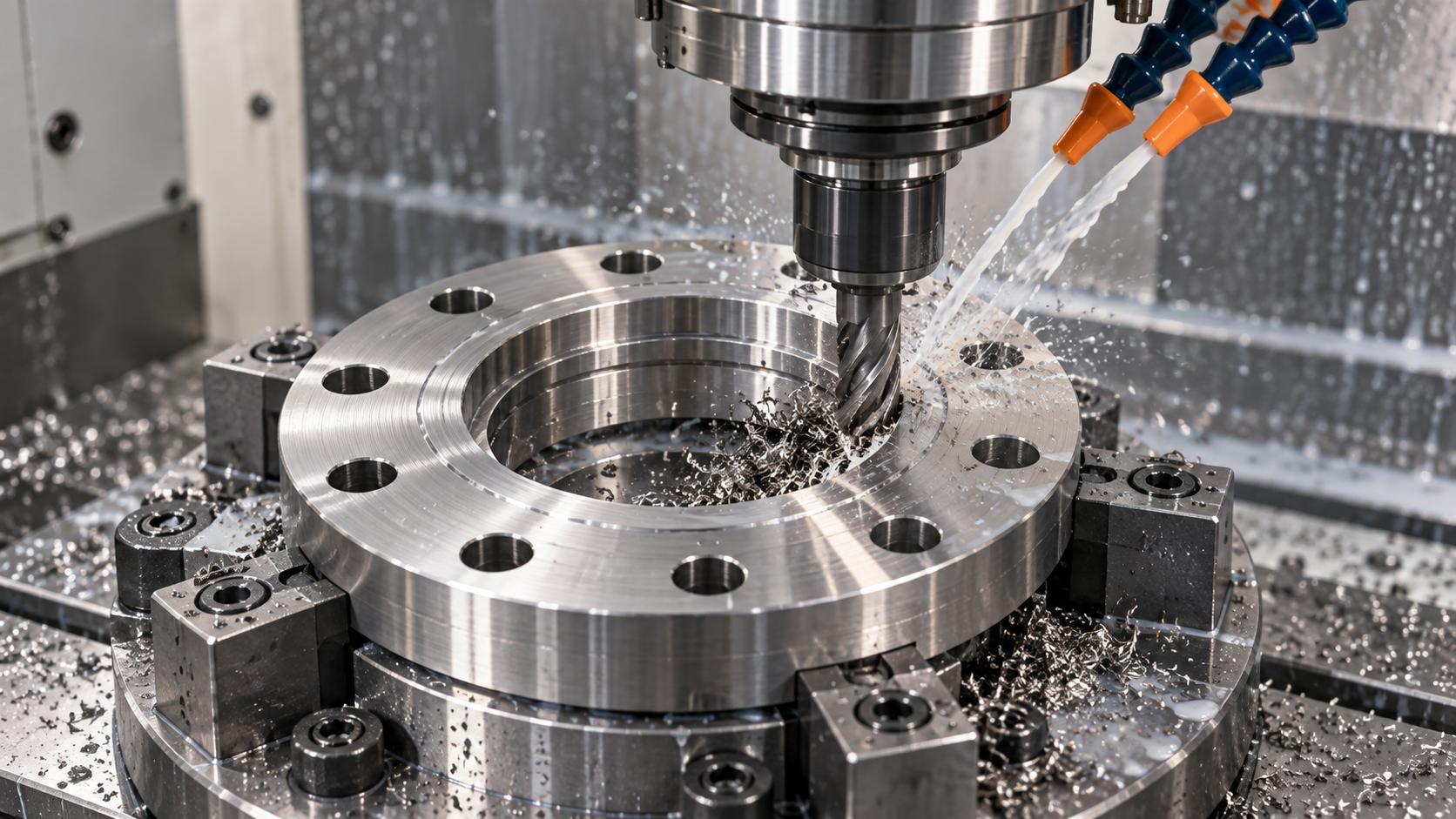
CNC turning is commonly used to establish the basic circular geometry of a titanium flange. Typical turning operations include machining the outside diameter, front and rear faces, center bore, shoulders, steps and circular grooves.
Producing several related features in a controlled setup can help maintain the dimensional relationship between the outside diameter, bore and sealing surfaces.
Machining the Center Bore
The center bore can be a functional locating or flow-related feature depending on the flange design. Its diameter may therefore require tighter control than a simple clearance opening.
Where concentricity between the bore and outside diameter is important, the machining sequence and workholding method should be planned to maintain their relationship. Additional internal steps, tapers or grooves can also be machined according to the drawing.
Bolt-Hole Pattern and PCD Accuracy
A flange usually contains several holes distributed around a pitch circle diameter, commonly described as the PCD or bolt circle. The quantity, diameter and angular spacing of these holes must match the corresponding mating component.
CNC milling or machining-center operations can position the bolt holes according to programmed coordinates. Depending on the design, holes may be drilled, reamed, countersunk, counterbored or threaded.
Through Holes, Counterbores and Threaded Holes
Not every titanium flange uses simple through holes. Custom designs may include threaded mounting holes, counterbores for bolt heads, countersinks, dowel holes or combinations of different hole types.
The drawing should identify hole depth, thread specification and any positional tolerance required. This becomes especially important when several different hole types appear on the same bolt circle.
Sealing Face Machining
Some flange designs include a functional face that contacts a gasket, seal or corresponding equipment surface. In these cases, face flatness and surface finish may be more important than the appearance of non-functional external areas.
The required surface condition should be specified on the drawing rather than assumed from the general flange geometry. Critical sealing surfaces can then be protected during subsequent handling and secondary processing.
Grooves for Seals and O-Rings
Custom titanium flanges may contain circular grooves for O-rings or other sealing elements. Groove diameter, width, depth and surface condition should follow the mating seal design.
Because these grooves are positioned relative to the center bore and sealing face, machining them in a controlled reference setup can help maintain dimensional consistency.
Flatness and Parallelism
The two main flange faces may require controlled flatness or parallelism, particularly when the component is clamped between mating surfaces. Removing material unevenly can also influence a thin flange after machining.
Machining allowance, clamping method and operation sequence should therefore be considered for components with thin sections or tighter face requirements.
Machining Thin Titanium Flanges
Thin flange components can require additional attention during workholding because excessive clamping force may influence the part during machining or inspection. This is particularly relevant when a large outside diameter is combined with relatively low thickness.
Suitable fixtures and machining sequences can help reduce unnecessary distortion while still providing sufficient support for turning, drilling and milling operations.
Custom Flanges with Irregular External Shapes
Not every flange is completely circular. Equipment-specific components may contain flats, mounting ears, cutouts, slots or asymmetric external features while retaining a circular bore or sealing area.
These designs can combine CNC turning with 3-axis, 4-axis or 5-axis milling depending on geometry and production requirements.
Deburring and Edge Treatment
Drilled holes, milled slots and machined edges should be checked for burrs before final inspection. Drawings may also specify chamfers or radii on selected flange edges.
Defined edge features should be machined according to the drawing rather than replaced by uncontrolled manual deburring, particularly where the edge forms part of an assembly interface.
Surface Finish Options
Custom titanium flanges can be supplied with an as-machined surface or additional finishing according to project requirements. The appropriate treatment depends on the application, material grade and required appearance or functional surface condition.
Critical bores, threads and sealing surfaces should be identified before secondary finishing so that dimensional and surface requirements can be maintained.
Inspection of CNC Machined Titanium Flanges
| Inspection Item | Typical Requirement |
|---|---|
| Outside Diameter | Size and drawing tolerance |
| Center Bore | Diameter and relationship to reference features |
| Bolt Holes | Diameter, quantity and positional accuracy |
| Thickness | Finished overall dimension |
| Faces | Flatness, parallelism and surface finish where specified |
| Grooves and Steps | Diameter, width, depth and position |
Prototype Titanium Flanges
Custom equipment projects often begin with one or several prototype flanges before moving into repeat production. Prototype machining allows dimensions, hole locations and mating relationships to be evaluated using the actual component.
For prototype orders, clearly identifying critical dimensions helps the machining team focus inspection on the features that have the greatest influence on assembly.
Small and Medium Batch Production
After a flange design has been confirmed, CNC programs, tooling methods and inspection references can be maintained for repeat production. Fixtures can also become more useful when the same bolt pattern or external geometry is produced regularly.
Production planning depends on flange diameter, thickness, titanium grade, machining complexity and required quantity rather than quantity alone.
Custom Titanium Flanges from Drawings
For drawing-based flange production, a 2D drawing provides tolerances, hole specifications and surface requirements, while a 3D model helps define the complete component geometry. Supplying both formats is useful for parts containing steps, grooves or irregular milled features.
Physical samples can also be reviewed when a customer needs machining support for an existing component and complete production data is not immediately available.
What to Include in a Titanium Flange RFQ
Information Helpful for Quotation
Please provide the titanium grade, outside diameter, thickness, center bore, bolt-hole quantity and PCD, thread details, sealing surface requirements, grooves or steps, tolerances, surface finish and quantity. A PDF drawing together with a STEP model is recommended for custom flange projects.
Custom Titanium Flange Machining from Sunrise Industrial
Sunrise Industrial manufactures titanium flanges and other custom titanium components according to customer drawings, models and samples. CNC turning, CNC milling, turn-mill machining, multi-axis machining and dimensional inspection can be combined according to component geometry and production requirements.
Need Custom Titanium Flanges?
Send us your drawing, titanium grade, flange dimensions, bolt-hole pattern, surface requirements and quantity for machining review and quotation.
Contact UsAbout Sunrise Industrial
Sunrise Industrial is an ISO 9001:2015 precision CNC machining and custom component manufacturer. We manufacture titanium flanges, prosthetic components, titanium CNC machined parts, titanium dental discs, titanium sputtering targets, titanium fasteners and other drawing-based custom components for OEM projects.