
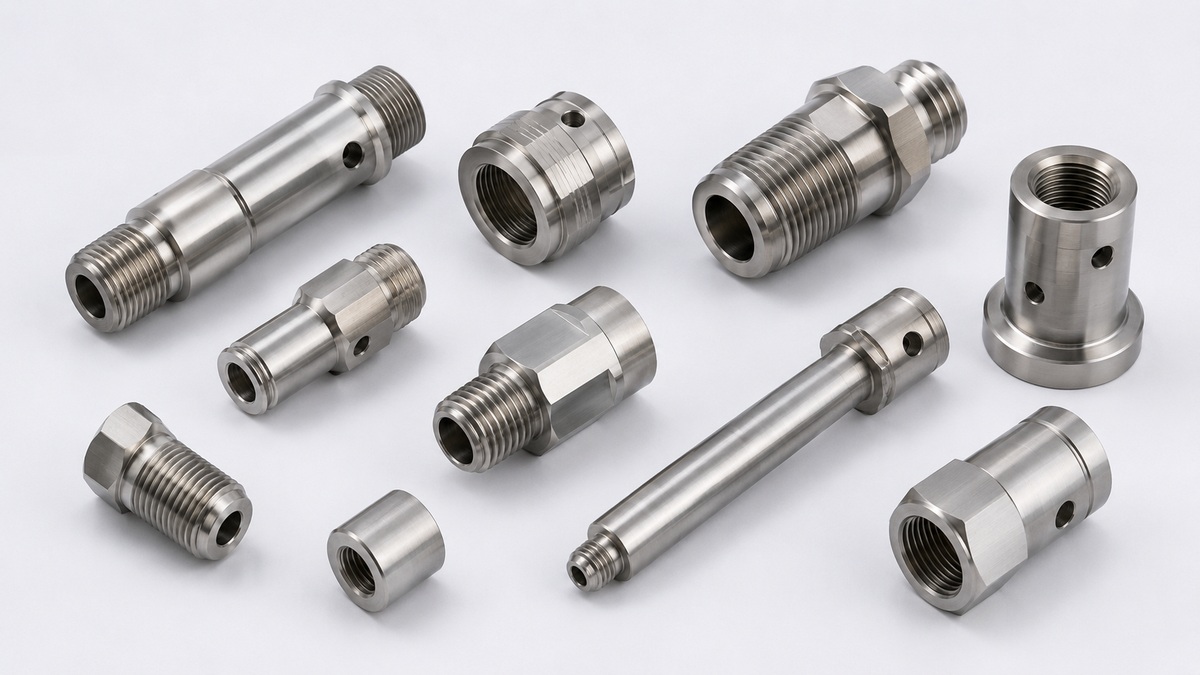
Titanium connectors are used in mechanical assemblies where two or more components need a precise, lightweight and corrosion-resistant connection. Unlike standard off-the-shelf fittings, custom titanium connectors may combine threads, bores, shoulders, grooves, mounting holes and special mating surfaces within one CNC machined component.
Sunrise Industrial manufactures custom titanium connectors according to customer drawings, 3D models and samples. Production can include CNC turning, milling, turn-mill machining, drilling, threading and secondary finishing for prototypes, small batches and repeat OEM orders.
What Is a Custom Titanium Connector?
A titanium connector is a component designed to join, position or interface with other parts in a mechanical assembly. The term covers many different geometries because the connector structure normally follows the requirements of the final equipment rather than a single standard shape.
A connector may be a simple threaded cylindrical part, a hollow coupling, a stepped connection piece or a more complex component combining turned and milled features. For OEM projects, the manufacturing drawing should define the functional interfaces rather than relying only on a general product description.
Common Features of CNC Machined Titanium Connectors
| Connector Feature | Machining Focus |
|---|---|
| External Threads | Diameter, pitch, thread length, runout and fit |
| Internal Threads | Thread depth, minor diameter and clean thread entry |
| Precision Bores | Inside diameter, concentricity, depth and surface finish |
| Shoulders and Steps | Axial dimensions and mating position |
| Cross Holes and Slots | Position, diameter, edge condition and relationship to other features |
| Mating Surfaces | Tolerance, flatness, finish and assembly fit |
Why Titanium Is Used for Connector Components
Titanium is often selected for custom connectors when the design requires a combination of relatively low weight, strength and corrosion resistance. These properties make titanium useful for selected industrial equipment, mechanical systems, medical-related assemblies, marine environments and other engineering projects.
Material selection should still be based on the actual working conditions. Load, temperature, corrosion environment, mating materials and component geometry can all influence the appropriate titanium grade and connector design.
Grade 5 Titanium for High-Strength Connectors
Ti-6Al-4V Grade 5 is commonly specified for CNC machined titanium components when higher mechanical strength is required. It is suitable for many connectors with threaded, stepped or structural features.
Because Grade 5 titanium requires suitable cutting conditions, machining plans should consider tool geometry, cutting speed, heat generation and chip evacuation. Stable workholding is also important when several features must remain accurately related to the same reference axis.
Grade 2 Titanium for Corrosion-Resistant Connector Parts
Commercially pure Grade 2 titanium can be selected for connectors where corrosion resistance and material formability are important and the design does not require the higher strength level of Ti-6Al-4V.
The material grade should be specified on the drawing or purchase requirement. Changing between Grade 2 and Grade 5 should not be treated as a simple material substitution because their mechanical properties and machining behavior are different.
CNC Turning for Round Titanium Connectors
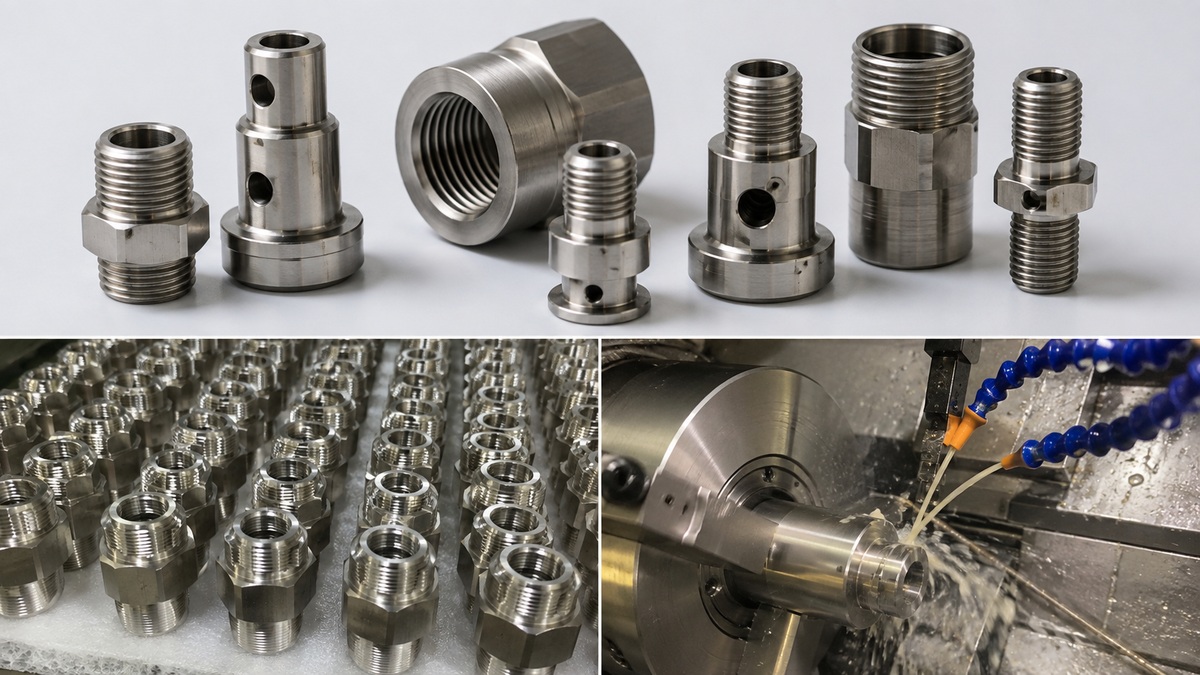
Many titanium connectors begin as round bar material and contain predominantly rotational features. CNC turning is suitable for producing outside diameters, shoulders, grooves, bores, chamfers and external or internal threads around a common centerline.
When several diameters must assemble with corresponding components, controlling concentricity and axial dimensions during the turning process can reduce variation in the final assembly.
When CNC Milling Is Also Required
A connector may begin as a turned component but still require milled flats, wrench surfaces, slots, cross holes or non-round mounting features. These operations can be completed in a separate milling setup or by turn-mill equipment depending on the geometry and production quantity.
For connectors with multiple angular features, careful datum selection helps maintain the correct relationship between turned diameters and milled details.
Turn-Mill Machining for Complex Connector Designs
Turn-mill machining can be useful when a connector contains both rotational and non-rotational geometry. Combining operations can reduce repeated repositioning and allow several features to be produced from common machining references.
Whether turn-mill machining is the most economical choice depends on component complexity, tolerance, quantity and setup requirements. Simpler connectors may still be produced more efficiently using conventional CNC turning followed by secondary milling.
Thread Machining in Titanium Connectors
Threads are among the most common functional features on connector components. Both external and internal threads need the correct size, pitch, usable length and fit with the corresponding mating part.
The drawing should identify the required thread standard and tolerance when these details are important. Blind internal threads also require attention to drilling depth, thread depth and the space available at the bottom of the hole.
Bores, Holes and Internal Connection Features
Hollow connectors may contain through bores, blind bores, stepped internal diameters or intersecting holes. These features can provide clearance, fluid passages, assembly space or interfaces for other components.
For deep bores, the ratio between diameter and depth affects machining difficulty and inspection access. Clearly defining which internal dimensions are functional helps the manufacturer select an appropriate machining and measurement method.
Mating Dimensions and Assembly Fit
A connector is normally only one part of a larger assembly, so its mating dimensions often matter more than non-functional external surfaces. Diameters, shoulders, threads, locating surfaces and hole positions should be reviewed together with the corresponding components.
When possible, customers can provide drawings or dimensional information for both sides of an important connection. This helps identify potential fit issues before machining begins.
Thin Walls and Weight-Reduction Features
Some titanium connector designs use thinner walls, internal pockets or reduced outside diameters to lower component weight. These features can be practical, but very thin sections may become more difficult to clamp and machine without deformation.
Weight reduction should therefore be considered together with structural requirements and manufacturability. Removing additional material does not always reduce total production cost if the resulting geometry requires slower machining or additional setups.
Surface Finish for Titanium Connectors
Custom titanium connectors can be supplied with a machined surface or receive additional finishing according to the project requirement. Depending on the component, possible processes may include polishing, blasting, anodizing or other specified treatments.
Functional threads, precision bores and mating surfaces should be considered before secondary finishing because some processes can influence surface condition or final dimensions.
Important Inspection Points
| Inspection Item | Typical Requirement |
|---|---|
| Outside Diameter | Size, tolerance and concentricity when specified |
| Internal Bore | Diameter, depth and surface condition |
| Threads | Thread gauge, pitch, length and fit |
| Shoulder Position | Axial distance and relationship to mating features |
| Cross Holes | Diameter, location and angular position |
| Surface | Burr removal, machining marks and specified finish |
Prototype and Small-Batch Titanium Connectors
New connector projects often begin with prototypes or a small trial quantity. This allows dimensions, assembly fit and manufacturing details to be reviewed before larger repeat orders are released.
For repeat production, approved CNC programs, fixtures and inspection references can be maintained to improve consistency between batches.
What to Include in a Titanium Connector RFQ
A complete RFQ helps the machining supplier evaluate material usage, machining operations and inspection requirements accurately. A 3D model is useful for understanding the full geometry, while a 2D drawing should identify tolerances, threads, surface finish and other critical requirements.
Quantity is also important because machining strategy and fixture planning can differ significantly between a prototype, a small batch and regular production.
Information Helpful for Quotation
Please provide the 2D drawing and 3D model when available, titanium grade, dimensions, tolerances, thread specifications, mating requirements, surface finish and estimated quantity. Information about the corresponding assembly components can also help with manufacturing review.
Custom Titanium Connector Manufacturing from Sunrise Industrial
Sunrise Industrial manufactures custom titanium connectors and other drawing-based precision components using CNC turning, CNC milling, turn-mill machining and related manufacturing processes. We support titanium as well as stainless steel, aluminum and other engineering materials according to project requirements.
Need Custom Titanium Connectors?
Send us your drawing, 3D model, titanium grade, thread details, tolerance requirements, surface finish and quantity for machining review and quotation.
Contact UsAbout Sunrise Industrial
Sunrise Industrial is an ISO 9001:2015 precision CNC machining and custom component manufacturer. We manufacture prosthetic components, titanium CNC machined parts, titanium dental discs, titanium sputtering targets, titanium fasteners and other drawing-based custom components for OEM projects.