
Prosthetic receivers are important interface components in modular lower-limb prosthetic assemblies. A receiver provides the female connection for a compatible male pyramid and allows different prosthetic components to be assembled into a modular system.
Although a receiver may appear to be a relatively small machined part, its internal geometry, adjustment screw positions, threads and relationship with the mating pyramid all require careful manufacturing control. Sunrise Industrial manufactures custom prosthetic receivers in titanium, stainless steel and aluminum according to customer drawings, samples and OEM requirements.
What Is a Prosthetic Receiver?
A prosthetic receiver is a female modular connector designed to accept a corresponding male pyramid. The two components form an adjustable mechanical interface used between different sections of a prosthetic assembly.
Receiver geometry can be integrated into socket adapters, tube adapters, double-ended adapters and other modular components. It can also be manufactured as an independent connector when required by the customer's design.
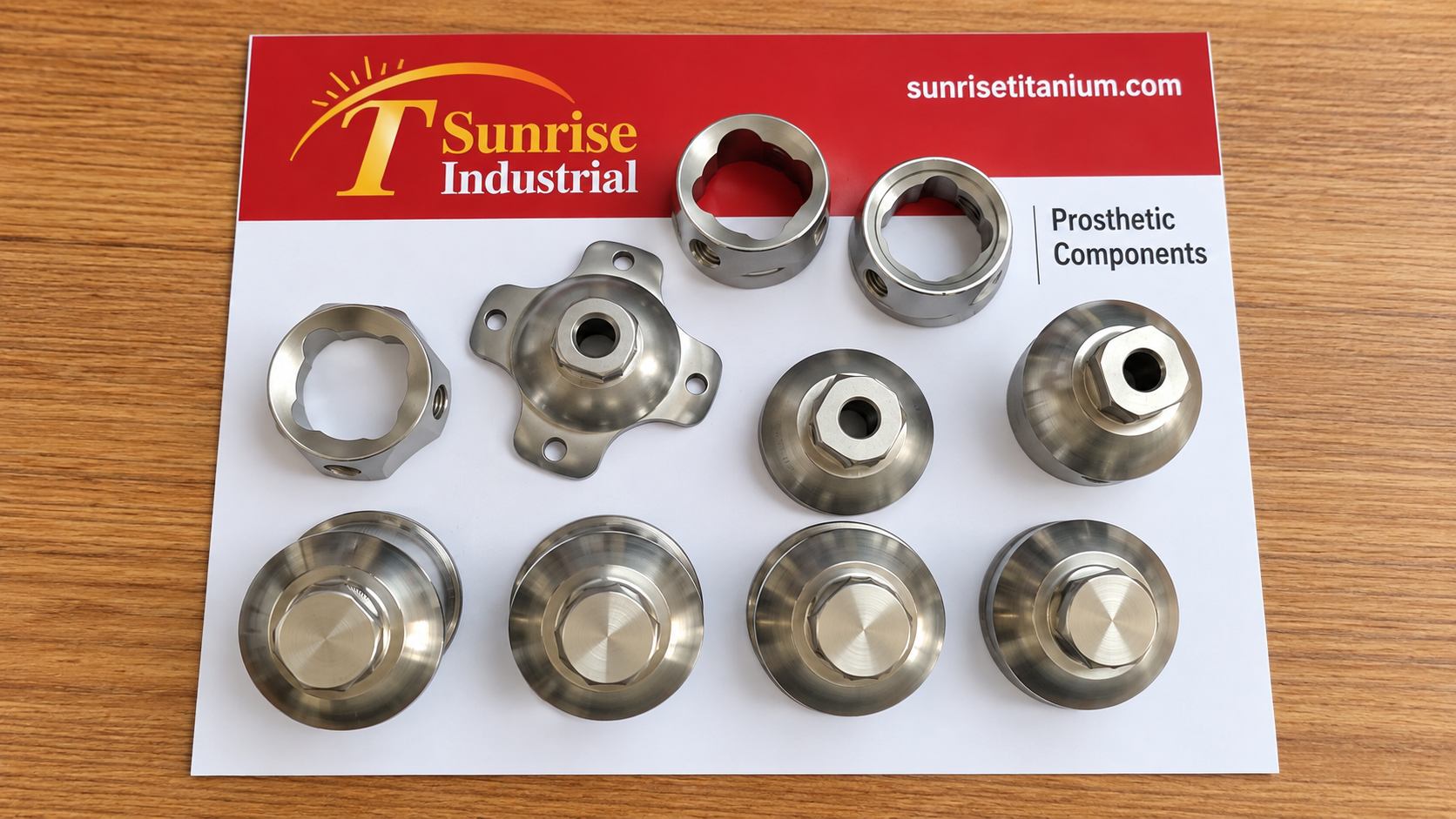
The Female Pyramid Interface
The central feature of a prosthetic receiver is its internal opening. This opening must accommodate the intended male pyramid while providing the contact arrangement required by the complete assembly.
Unlike a simple cylindrical bore, a pyramid receiver can contain multiple angled or contoured surfaces. Its functional geometry therefore needs to be manufactured in relation to the centerline, screw positions and surrounding receiver body.
Why Pyramid and Receiver Geometry Must Be Considered Together
A receiver should not be evaluated only by its external dimensions. The most important relationship is between the receiver, the male pyramid and the adjustment screws that connect the two components.
For custom OEM projects, drawings of both mating components are especially useful. They allow the manufacturing team to understand the available clearance, contact surfaces and screw locations instead of evaluating each part independently.
Common Prosthetic Receiver Configurations
| Receiver Type | Typical Structure |
|---|---|
| Female Pyramid Receiver | Independent female interface for a compatible male pyramid |
| Receiver Socket Adapter | Receiver combined with a socket-side mounting structure |
| Receiver Tube Adapter | Female pyramid interface combined with a tube or pylon connection |
| Double-Ended Receiver Adapter | Receiver incorporated into an intermediate modular adapter |
| Custom Receiver | Drawing-specific opening, body, threads, screw arrangement or mounting geometry |
Titanium Prosthetic Receivers
Titanium is frequently selected for precision prosthetic adapters when the design requires a combination of mechanical strength, relatively low weight and corrosion resistance. Ti-6Al-4V is a common material for CNC machined structural components, subject to the material specification defined by the customer.
Because several adapters may be used in one modular assembly, component weight can become an important design consideration. Titanium allows designers to develop compact structural components while maintaining the geometry required by their application.
Stainless Steel and Aluminum Receivers
Stainless steel is another option for prosthetic receivers and related adapters. It may be selected according to the required mechanical properties, product design, manufacturing route and target cost.
Aluminum can also be machined for selected adapter designs when specified by the customer. The appropriate material should therefore be determined from the complete product requirements rather than from the receiver shape alone.
Adjustment Screw Position and Contact
Adjustment screws are an important part of many pyramid-receiver assemblies. Their location determines where the screw tips contact the pyramid and influences the available adjustment relationship between the mating components.
The screw hole angle, thread position, thread depth and distance from the receiver center should follow the customer's controlled drawing. When the screw tip geometry is specified, it is also useful to review how that tip contacts the corresponding pyramid surface.
Thread Quality in Prosthetic Receivers
Receivers often contain several threaded holes positioned around a relatively compact body. Accurate thread production is important because the screws must install smoothly and reach the intended contact area.
Thread inspection should consider size, pitch, depth and functional condition. Burrs around the thread entrance should be controlled, and threaded areas may require protection or additional inspection when subsequent surface finishing could affect their fit.

CNC Machining a Prosthetic Receiver
A receiver may require several machining processes because it commonly combines rotational geometry with non-rotational internal and external features. CNC turning can be used for round diameters, faces, shoulders and bores, while CNC milling can produce the receiver opening, flats, slots and cross holes.
Turn-mill and multi-axis CNC equipment can reduce repeated setups for suitable designs. The manufacturing route should be selected according to geometry, tolerances, material, quantity and the relationship between critical features.
Deep Internal Features and Tool Access
Some custom receiver designs contain relatively deep internal cavities or narrow openings. These structures can make tool access more difficult, particularly when the outer diameter is restricted while the internal feature must remain deep.
Tool length, cutter rigidity, chip evacuation and available wall thickness should therefore be considered during manufacturing review. Small changes to non-functional geometry can sometimes simplify machining while preserving the required mating interface, but any design change should be approved by the customer before production.
Wall Thickness and External Diameter
Reducing the external diameter of a receiver may lower material usage and component weight, but it also reduces the space available around the internal opening and threaded screw holes.
For this reason, receiver diameter, cavity size, screw thread depth and minimum wall thickness should be evaluated together. A design that is compact in CAD may require a more demanding machining strategy when produced from titanium or stainless steel.
Controlling Receiver Opening Dimensions
The receiver opening is a functional interface rather than a purely cosmetic feature. Its dimensions influence how the mating pyramid enters the receiver and how the surrounding contact geometry interacts with the adjustment screws.
Inspection requirements should therefore be based on the customer's drawing and mating design. Where appropriate, a corresponding pyramid or inspection sample can be used as an additional functional reference during prototype development.
Surface Finish and Functional Areas
Prosthetic receivers may require bead blasting, shot blasting, polishing, coating or other customer-specified finishes. Functional interfaces and threaded areas, however, need additional consideration because surface treatment can influence dimensions or thread condition.
Where necessary, critical holes and threads can be protected during finishing or inspected again afterward. The appropriate process depends on the material, finish specification and tolerance requirements of the individual component.
Receiver Inspection Requirements
| Inspection Area | Typical Check |
|---|---|
| Receiver Opening | Drawing-defined dimensions, profile and position |
| Adjustment Screw Holes | Position, angle, thread and depth |
| External Geometry | Diameter, height, shoulders and mounting features |
| Threads | Thread gauge or functional inspection as applicable |
| Mating Interface | Assembly relationship with the specified pyramid when required |
Producing Receivers from Customer Samples
Existing prosthetic components can provide useful reference information when a customer wants to develop a compatible or modified receiver. Measurements can help establish the overall envelope, interface arrangement and thread locations.
For repeat OEM production, the final component should be controlled by an approved drawing or 3D model that clearly defines material, dimensions, tolerances and surface requirements. This provides a consistent manufacturing reference for future batches.
Prototype Development Before Batch Production
When developing a new receiver, prototype machining provides an opportunity to verify the physical relationship with the mating pyramid before larger quantities are produced.
This is particularly useful for custom interface geometry, new screw arrangements or receiver families intended to work with several related adapters. After assembly is confirmed, the machining and inspection process can be standardized for repeat production.
Standardizing a Modular Adapter Family
For OEM customers developing several prosthetic adapters, using consistent pyramid and receiver interfaces across the product family can simplify component compatibility. The same interface concept may be incorporated into socket adapters, tube adapters, double-ended adapters and other connector designs.
External geometry can still vary according to the function of each component. The objective is to control the mating interface while allowing each adapter to retain the dimensions and structural features required for its specific position in the assembly.
What to Provide for a Custom Receiver Quotation
Useful RFQ Information
For quotation and manufacturing review, please provide the 2D drawing or STEP model, material grade, receiver opening geometry, adjustment screw specifications, external dimensions, surface finish and required quantity. Information about the mating pyramid is also helpful for custom interface projects.
Custom Prosthetic Receivers from Sunrise Industrial
Sunrise Industrial manufactures custom prosthetic receivers and related modular components according to customer drawings and samples. Our machining capabilities include CNC turning, 3-axis, 4-axis and 5-axis milling, turn-mill machining and dimensional inspection for titanium, stainless steel and aluminum components.
Need a Custom Prosthetic Receiver?
Send us your receiver drawing, STEP model, material specification, mating pyramid information and quantity for manufacturing review and quotation.
Contact UsAbout Sunrise Industrial
Sunrise Industrial is an ISO 9001:2015 precision CNC machining and custom component manufacturer. We manufacture prosthetic components, titanium CNC machined parts, titanium dental discs, titanium sputtering targets, fasteners and other drawing-based custom components for OEM projects.