
Titanium threaded parts are used in assemblies where a threaded connection must be combined with low weight, corrosion resistance and precisely machined geometry. In many custom components, the thread is only one feature of a more complex part that may also include shoulders, bores, flanges, slots, sealing surfaces or mounting features.
Machining threads in titanium requires more attention than simply selecting the correct thread size. Titanium retains heat near the cutting zone, can produce high cutting forces and has a tendency to gall when mating surfaces slide under load. Tool selection, cutting parameters, coolant delivery and inspection therefore play an important role in producing consistent threaded components.
What Are Custom Titanium Threaded Parts?
Custom titanium threaded parts are drawing-based CNC components containing internal threads, external threads or both. Unlike standard commercial fasteners, these parts are usually designed as functional elements of a larger assembly.
Typical examples include:
- Threaded titanium connectors
- Threaded sleeves and bushings
- Custom studs and threaded shafts
- Internally threaded adapters
- Threaded collars and retaining components
- Flanged threaded components
- Threaded housings and end fittings
- Components with radial or angled threaded holes
The surrounding geometry often determines how the thread should be machined. A deep internal thread in a narrow bore, for example, presents different tooling and chip-control requirements from a short external thread on a turned shaft.
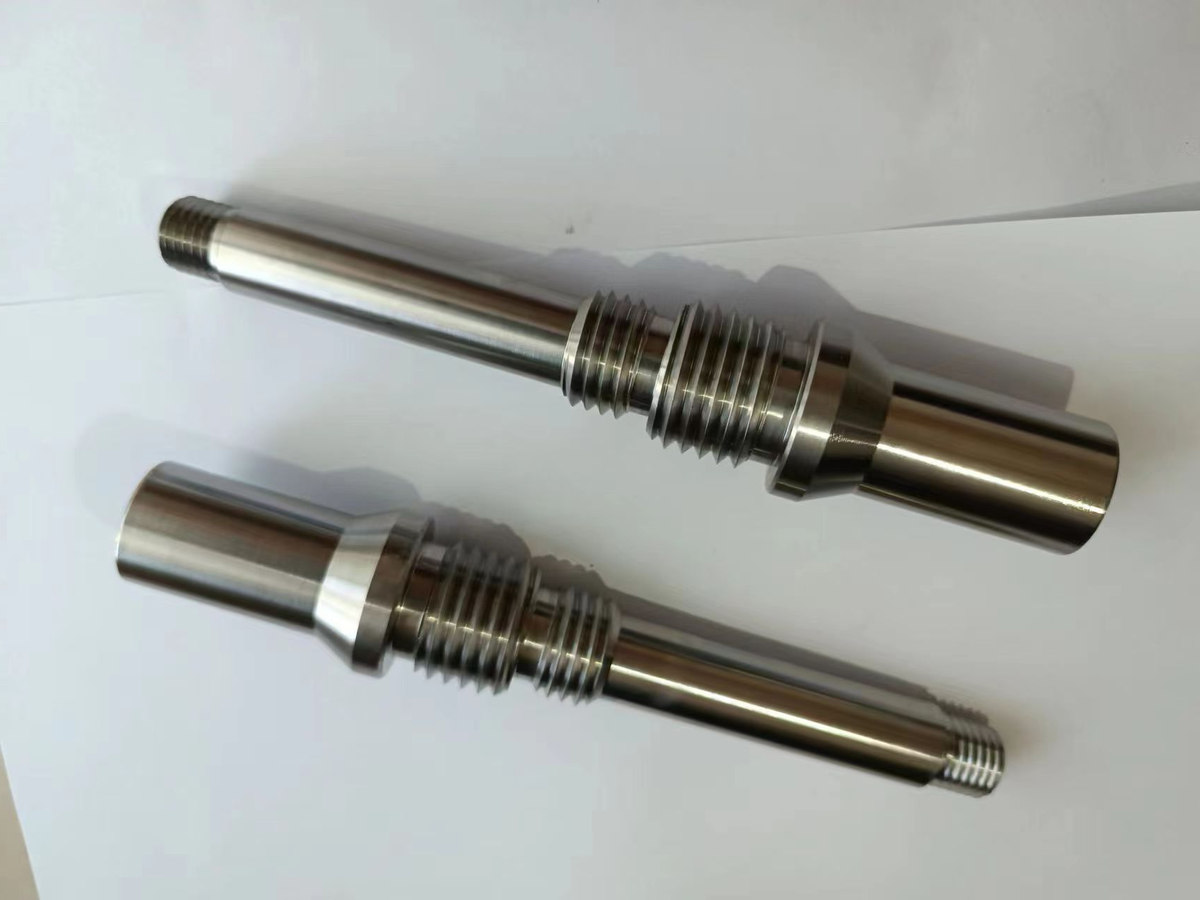
Internal vs. External Titanium Threads
External threads are commonly produced on CNC lathes when the threaded feature shares an axis with the main body of the component. Turning allows the outside diameter, shoulders and thread to be produced within the same setup, helping maintain concentricity between related features.
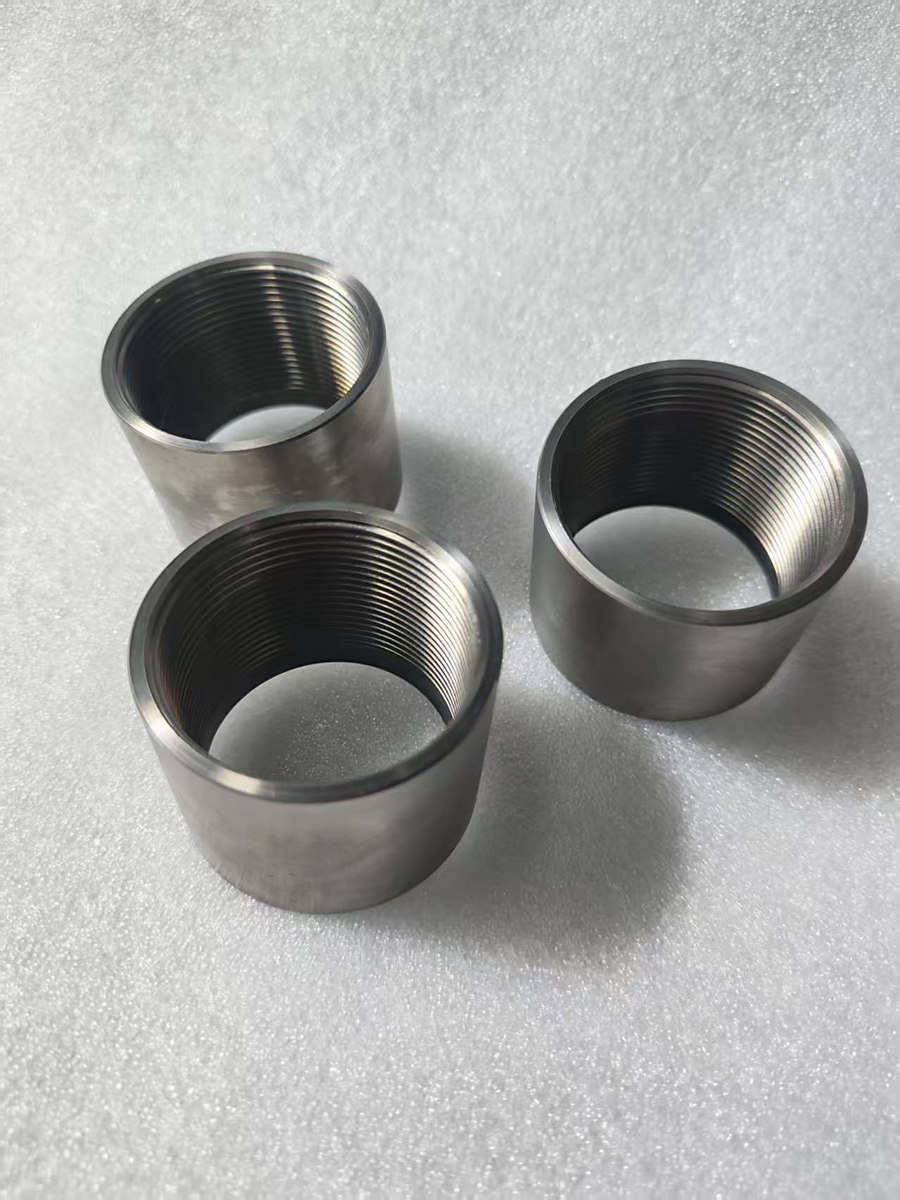
Internal threads can be more challenging because tool access, chip evacuation and coolant delivery are restricted by the bore. Blind holes add another consideration because the cutting tool requires sufficient clearance at the end of the thread.
For both types, the drawing should clearly identify thread standard, nominal size, pitch, thread length or depth and any required tolerance class. These details allow the manufacturing process and inspection method to be selected before production begins.
CNC Thread Turning
Thread turning is a common method for producing internal and external threads on rotational titanium components. A CNC lathe synchronizes tool movement with spindle rotation to generate the required pitch.
Rather than attempting to form the complete thread profile in one cut, the tool normally makes multiple controlled passes. This distributes the cutting load and allows the thread to develop progressively to its final dimensions.
For custom parts, thread turning also offers flexibility because different thread diameters and pitches can be produced without relying on a dedicated tap for every configuration.
Thread Milling for Complex Components
Thread milling can be useful when threaded features are produced on a CNC machining center rather than a lathe. The cutter follows a helical toolpath to generate the thread inside or outside the component.
This process can be particularly useful for larger threaded holes, components with multiple threaded locations or parts where the thread is positioned on a milled face. It can also provide greater control when producing threads close to the bottom of certain blind holes.
On components with several side ports or threaded connections, multi-axis machining may reduce the number of times the workpiece needs to be repositioned.

Why Titanium Threads Need Careful Process Control
Titanium has relatively low thermal conductivity compared with many commonly machined metals. A larger portion of machining heat therefore remains around the cutting edge rather than being carried away through the workpiece.
Threading also concentrates cutting activity within a relatively small area. Appropriate cutting parameters and effective coolant delivery help manage heat and reduce premature tool wear.
A worn threading tool can gradually change the thread profile or effective size even when the CNC program itself has not changed. For repeat production, monitoring tool condition is therefore part of maintaining consistent thread quality.
Titanium Thread Galling and Mating Components
Galling is an important consideration when titanium threaded surfaces repeatedly contact or slide against mating parts. Under unsuitable assembly conditions, friction can damage the thread surfaces and make disassembly difficult.
The appropriate solution depends on the application and should be determined by the customer's design requirements. Thread fit, surface condition, mating material, assembly procedure and any specified lubricant or coating can all influence the behavior of the connection.
From a machining perspective, clean thread surfaces and controlled geometry provide a reliable starting point for subsequent assembly requirements.
Thread Reliefs, Chamfers and Runout
Small details around the thread can have a significant effect on manufacturability. An external thread may require a relief near a shoulder so the threading tool can complete the profile without interfering with the adjacent surface.
Internal threads in blind holes need adequate bottom clearance, while an entry chamfer can help guide the mating component and protect the first thread during assembly.
When space is limited, the drawing should clearly define where the functional thread must begin and end. This is especially important on compact custom components where threads are positioned close to shoulders, sealing surfaces or other machined features.
Threads Combined With Precision CNC Features
Many titanium threaded parts require more than threading alone. A threaded connector, for example, may also contain a precision bore and locating shoulder. A threaded housing may combine several radial ports with sealing surfaces, while a shaft may require an external thread together with bearing diameters and milled flats.
The machining sequence should maintain the relationship between these features. Where practical, critical diameters, shoulders and threads can be machined in the same setup to reduce accumulated positioning error.
Turn-mill equipment and 4-axis or 5-axis machining can be useful when a component combines rotational geometry with side holes, flats, slots or off-axis threaded features.
Inspection of Titanium Threads
Thread inspection should verify that the finished component will mate correctly with the corresponding assembly. Plug gauges and ring gauges are practical methods for checking many standard internal and external threads.
Additional measurements may be required when a drawing specifies particular pitch diameter, position or geometric relationships. The surrounding features should also be inspected because a correct thread cannot compensate for a bore, shoulder or mounting surface that is incorrectly positioned.
For repeat batches, inspection records and controlled gauges can help maintain consistency between production runs.
Design Information for a Titanium Threaded Part RFQ
Providing complete thread information helps reduce uncertainty during quotation and production. A drawing should specify the titanium grade, thread standard, size and pitch, required thread length or depth, dimensional tolerances and the geometry of the surrounding component.
For custom CNC parts, it is also useful to provide a 3D model together with the 2D drawing when the geometry includes several intersecting or multi-axis features. Production quantity, surface requirements and inspection requirements should be included in the RFQ as well.
Custom Titanium Threaded Parts from Sunrise Industrial
Sunrise Industrial manufactures drawing-based titanium components using CNC turning, CNC milling, turn-mill machining and multi-axis machining. Threaded features can be incorporated into custom connectors, sleeves, shafts, housings, flanges, adapters and other precision CNC machined parts.
Our focus is custom component manufacturing rather than supplying only standard commercial fasteners. Projects can include prototype quantities, trial production and repeat batches according to the customer's drawings and technical requirements.
Material, thread geometry, machining sequence and inspection requirements are reviewed according to each component so that the threaded feature works together with the rest of the machined part.
Need Custom Titanium Threaded Parts?
Send Sunrise Industrial your 2D drawing or 3D model with the titanium grade, thread specification, quantity and tolerance requirements. We can review the component and provide a quotation for custom CNC machining.