
Custom titanium pump impellers are precision-engineered rotating components used in selected pumping systems where corrosion resistance, mechanical performance and dimensional accuracy are important. For pump manufacturers and industrial equipment OEMs, titanium can be an attractive material option when the operating environment justifies its cost and manufacturing requirements.
An impeller is not simply a rotating metal disc with blades. Its hub geometry, blade profile, flow passages, mounting bore and dimensional relationships can directly influence the operation of the pump assembly. Manufacturing these features requires a suitable machining strategy and careful inspection.
Sunrise Industrial provides custom titanium CNC machining services for drawing-based industrial components. This article explains the manufacturing considerations for titanium pump impellers, including material selection, CNC turning and milling, complex blade machining, dimensional inspection and OEM purchasing requirements.
1. What Is a Titanium Pump Impeller?
A pump impeller is a rotating component that transfers mechanical energy from a drive shaft to a fluid. Its geometry is designed according to the pump type, operating conditions and required hydraulic performance.
Titanium impellers may be considered for selected applications involving corrosive fluids or other demanding operating conditions. The final suitability of the material depends on the specific fluid chemistry, temperature, pressure, rotational speed and mechanical loading.
Common impeller configurations include:
- Open impellers with exposed blades
- Semi-open impellers with a single shroud
- Closed impellers with enclosed flow passages
- Small precision pump impellers
- Custom centrifugal pump impeller components
- Impeller hubs and related rotating components
Each configuration presents different manufacturing challenges. Open designs may provide better tool access, while enclosed passages and complex curved surfaces can require specialized manufacturing methods or multi-stage processes.
2. Why Use Titanium for Pump Impellers?
Titanium offers a combination of useful material characteristics for selected industrial pump components.
Corrosion Resistance
Titanium develops a protective oxide layer that provides resistance to corrosion in many environments. This can make it useful in certain seawater, chloride-containing or chemically demanding applications, subject to engineering evaluation.
Lower Density than Stainless Steel
Titanium has a lower density than common stainless steels. For a rotating component, material density can influence mass and rotational inertia, although the overall mechanical design remains critical.
Mechanical Performance
Titanium alloys such as Ti-6Al-4V offer high strength relative to their weight. This may be beneficial for appropriately designed rotating components where strength and mass are important considerations.
Application-Specific Limitations
Titanium is not universally corrosion-proof or suitable for every pump. Erosion, cavitation, galling, chemical compatibility, fatigue and temperature must be considered. Material selection should be based on the actual operating environment and the pump manufacturer's engineering requirements.
3. Grade 2 vs Grade 5 Titanium for Pump Components
Commercially pure Grade 2 titanium and Grade 5 Ti-6Al-4V alloy are two possible material options for custom titanium pump parts.
| Consideration | Grade 2 Titanium | Grade 5 Titanium |
|---|---|---|
| Material | Commercially pure titanium | Ti-6Al-4V alloy |
| Strength | Lower strength | Higher strength |
| Corrosion Behavior | Excellent resistance in many environments | Good resistance in many environments |
| Selection Focus | Corrosion and design requirements | Higher mechanical strength requirements |
The appropriate titanium grade must be selected by the OEM according to fluid compatibility, structural requirements, rotational loading and the applicable material specification. Neither grade should be substituted without engineering approval.
4. CNC Machining of Titanium Impeller Hubs and Mounting Features
Many pump impellers contain rotationally symmetrical features that can be manufactured through CNC turning. These may include the central hub, mounting faces, shaft bore and external diameters.
The hub connects the impeller to the drive shaft or another rotating assembly. Its dimensions and mounting arrangement are important for assembly accuracy.
Common machined features include:
- Precision shaft bores
- Hub outside diameters
- Mounting shoulders and locating faces
- Threaded mounting features
- Keyways or other shaft connection details
- Axial reference surfaces
The required tolerances depend on the shaft connection, rotational speed, assembly design and the customer's engineering specifications. Features such as concentricity and runout should be defined where functionally necessary.
5. CNC Milling of Titanium Impeller Blades
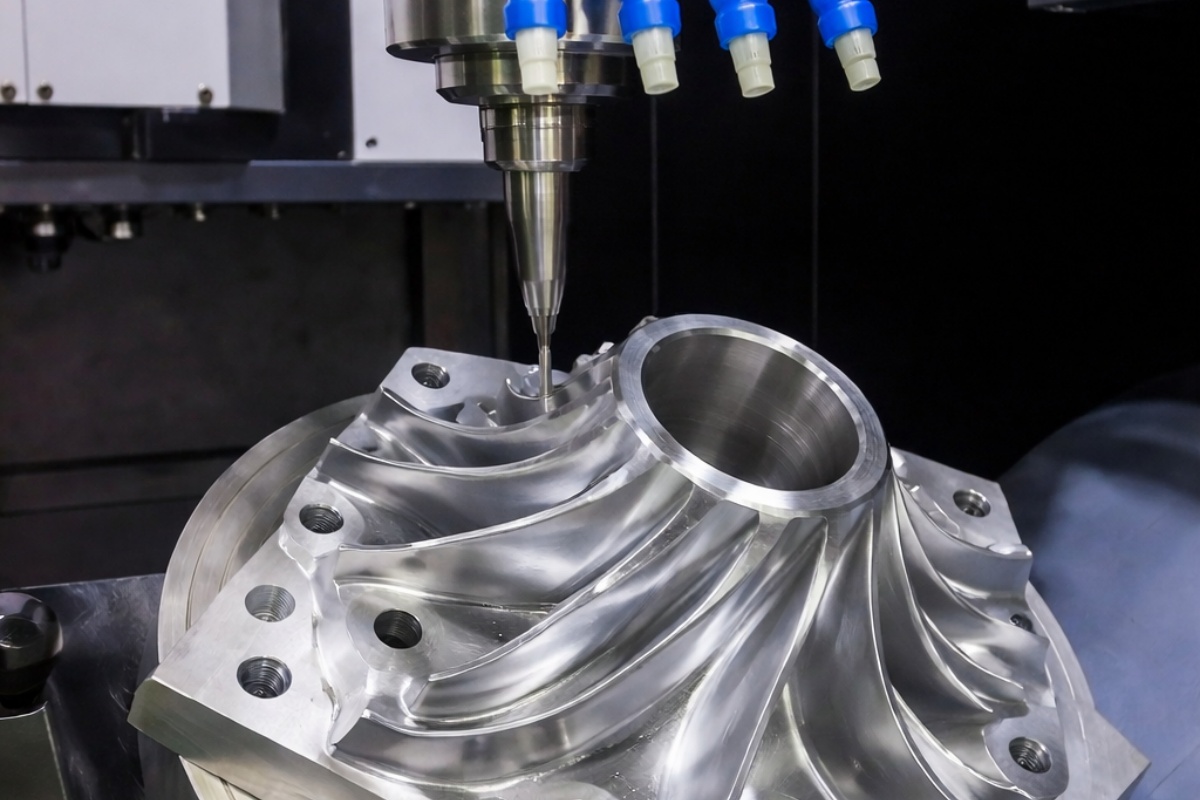
Impeller blades are often more challenging to machine than the central hub because they may involve curved surfaces, varying thicknesses and narrow spaces between adjacent blades.
For suitable open impeller designs, multi-axis CNC milling can provide access to complex blade profiles and reduce the number of workpiece repositioning operations.
Manufacturing considerations include:
- Blade curvature and surface geometry
- Minimum blade thickness
- Tool access between adjacent blades
- Cutting forces and workpiece support
- Tool deflection and surface finish
- Material removal volume
- Machining time and inspection accessibility
Titanium requires appropriate cutting parameters, tooling and heat management. Complex impeller machining should be reviewed before quotation to determine whether the design can be produced efficiently and accurately with the available equipment.
Closed impellers with inaccessible internal flow passages may not be suitable for machining as a single piece from solid stock. Alternative manufacturing methods or design arrangements may be required.
6. Open vs Closed Impellers: Manufacturing Differences
The impeller design has a major influence on manufacturing feasibility.
Open Impellers
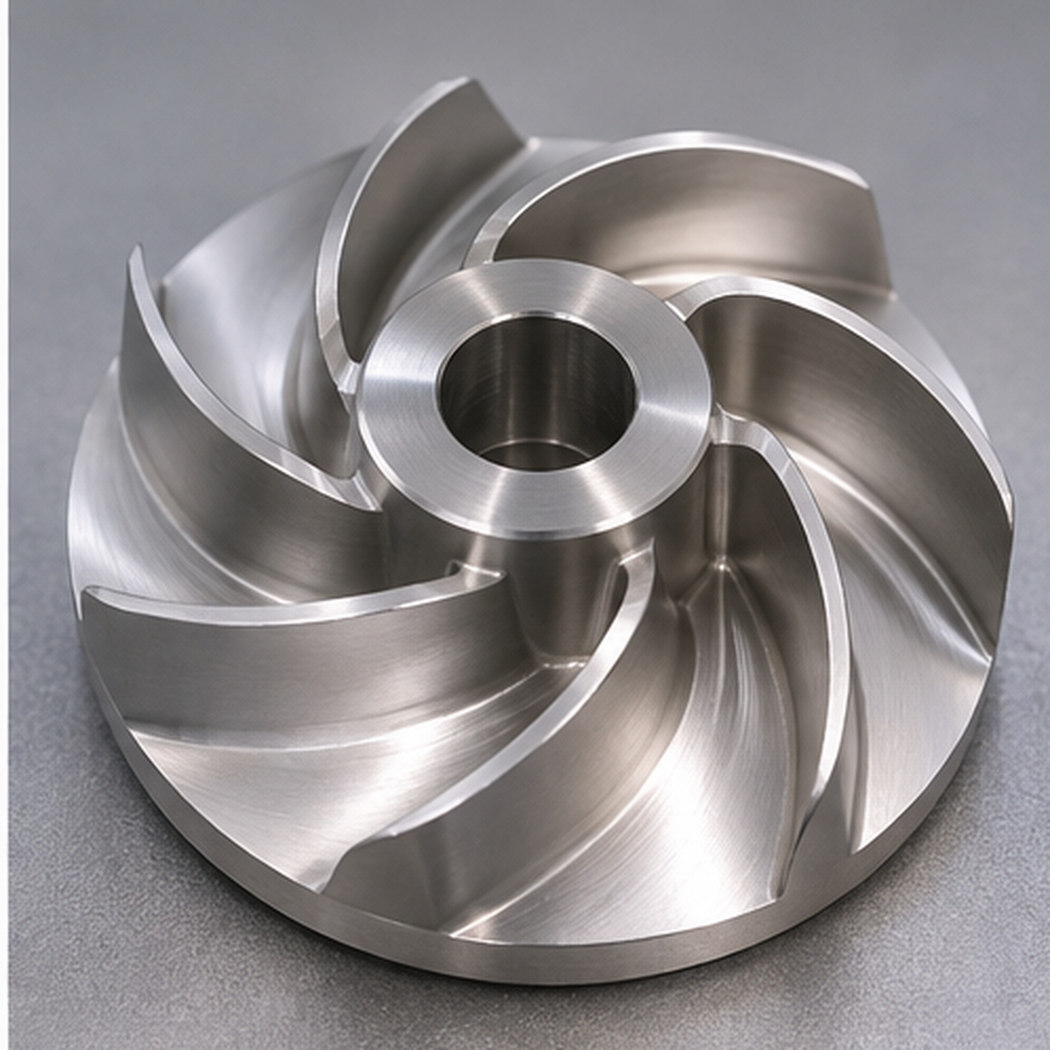
Open impellers have exposed blades and may offer better machining accessibility. For suitable geometries, CNC milling from solid titanium stock can be considered.
Semi-Open Impellers
Semi-open impellers incorporate a shroud on one side. Tool access depends on blade spacing, curvature and the relationship between the blades and the shroud.
Closed Impellers
Closed impellers contain enclosed flow passages that can be difficult or impossible to reach using conventional cutting tools. Depending on the design, casting, additive manufacturing or a separately engineered assembly process may be considered by the OEM.
7. Controlling Blade Thickness, Runout and Dimensional Accuracy
The dimensional requirements of a titanium impeller depend on the approved design and operating conditions.
Critical inspection features may include:
- Impeller outside diameter
- Hub and shaft bore dimensions
- Blade thickness and profile
- Axial and radial runout
- Mounting face geometry
- Concentricity of rotating features
- Surface condition and edge quality
Appropriate dimensional inspection may involve micrometers, bore gauges, optical measuring equipment and coordinate measuring methods where necessary.
Dimensional inspection alone does not establish dynamic balance, hydraulic efficiency, fatigue performance or safe operating speed. These characteristics require separate evaluation and testing according to the pump manufacturer's specifications.
8. Surface Finish and Deburring of Titanium Impellers
Machined blade surfaces and flow passages should meet the surface finish requirements defined by the customer.
Burrs and sharp edges may require controlled finishing. However, excessive polishing or uncontrolled material removal can change blade thickness, edge geometry or other critical features.
For functional impeller surfaces, the finishing process should be selected according to the approved design and inspection criteria.
If special surface treatments are required, their suitability for the titanium grade and operating environment should be reviewed before production.
9. Prototype and Small-Batch Titanium Impeller Manufacturing
Pump development projects may begin with a prototype impeller or a small quantity of test components.
Prototype machining allows the OEM to evaluate the geometry, assembly fit and manufacturability of a proposed design.
For complex blade shapes, the initial manufacturing review should consider:
- Availability of a complete 3D model
- Minimum blade thickness and tool access
- Raw material dimensions
- Suitable machining equipment
- Fixture requirements
- Inspection and testing responsibilities
- Expected repeat production quantities
Following prototype approval, repeat production may use controlled machining programs and inspection procedures. Any engineering changes should be documented and approved before the next production batch.
10. What Affects the Cost of Custom Titanium Impellers?
Titanium impeller manufacturing costs vary significantly with design complexity and production requirements.
Important cost factors include:
- Material grade: Grade 2 and Grade 5 have different material and machining characteristics.
- Impeller diameter: Larger components generally require more raw material and suitable machining capacity.
- Blade complexity: Curved profiles and narrow passages can increase programming and machining time.
- Machining accessibility: Inaccessible internal features may require alternative processes.
- Tolerances: Tight dimensional requirements can increase inspection and finishing work.
- Production quantity: Setup and programming costs are distributed differently between prototypes and repeat orders.
- Additional verification: Specialized inspection, balancing and testing requirements must be considered separately.
A complete 3D model and technical drawing help the manufacturer assess feasibility and prepare a more accurate quotation. For complex impellers, pricing should not be based on diameter and material alone.
11. What Should OEM Buyers Include in a Titanium Impeller RFQ?
For a custom titanium impeller quotation, buyers should provide:
- 3D STEP model and dimensioned 2D drawing
- Required titanium grade and material specification
- Impeller type and overall dimensions
- Blade profile and critical tolerances
- Shaft bore and mounting requirements
- Surface finish and inspection specifications
- Prototype and expected production quantities
- Any required balancing or performance testing
- Target delivery schedule
The manufacturer can then review machining accessibility, raw material requirements, tooling, workholding and inspection feasibility before confirming the quotation.
12. Custom Titanium Pump Component CNC Machining at Sunrise Industrial
Sunrise Industrial is a precision CNC machining manufacturer based in Xi'an, China, specializing in titanium and other custom metal components manufactured according to customer drawings.
Our machining capabilities include CNC turning, milling, turn-mill operations and selected multi-axis machining for complex industrial parts.
For titanium pump-related projects, we can review impeller hubs, shaft connectors, sleeves, threaded components and selected impeller geometries according to the customer's engineering specifications and manufacturing feasibility.
Sunrise Industrial operates under an ISO 9001:2015 quality management system and supports prototype evaluation, small-batch machining and repeat OEM production.
Our role is to provide precision-machined components according to agreed drawings and inspection requirements. Final pump design, hydraulic performance, dynamic balancing, operating-speed qualification and application-specific validation remain the responsibility of the relevant OEM or system manufacturer.
Frequently Asked Questions
Can titanium pump impellers be CNC machined from solid bar stock?
Some impeller geometries, particularly accessible open designs, can be machined from suitable solid stock. Manufacturing feasibility depends on the blade geometry, size, tool access and equipment.
Can Grade 2 titanium be used for pump impellers?
Grade 2 may be considered for selected designs, but its suitability depends on mechanical loading, fluid compatibility and the OEM's engineering requirements.
Is Grade 5 titanium suitable for high-strength impeller components?
Grade 5 provides higher strength than commercially pure titanium, but final suitability must be established through design analysis and application-specific testing.
Can a closed titanium impeller be CNC machined in one piece?
Not always. Enclosed flow passages may prevent cutting-tool access, requiring a different manufacturing method or a redesigned assembly.
Does dimensional inspection replace dynamic balancing?
No. Dimensional inspection and dynamic balancing evaluate different characteristics. Balancing requirements should be specified separately by the OEM.
Can Sunrise Industrial evaluate prototype titanium impellers?
Yes. Prototype machining requests can be reviewed based on the engineering drawings, material, blade geometry, quantity and available machining capabilities.
What information is needed for a titanium impeller quotation?
A STEP model, 2D drawing, material specification, quantity, critical tolerances and inspection requirements are recommended for an accurate manufacturing review.
Looking for Custom Titanium Pump Components?
Sunrise Industrial provides drawing-based CNC machining for titanium pump components, impeller hubs, precision shafts, sleeves, threaded connectors and selected custom impeller designs.
Send us your 2D drawings, STEP files, material requirements and quantities. Our team can evaluate machining feasibility and prepare a quotation for suitable OEM projects.
Request a CNC Machining Quote