
Custom titanium manifolds can combine multiple ports, internal passages, threaded connections and mounting features within a single machined component. They are used in specialized fluid, gas and equipment assemblies where the material and geometry are defined by the customer's engineering requirements.
Compared with a simple turned component, a manifold often requires machining from several directions while maintaining accurate relationships between intersecting holes and external connection features.
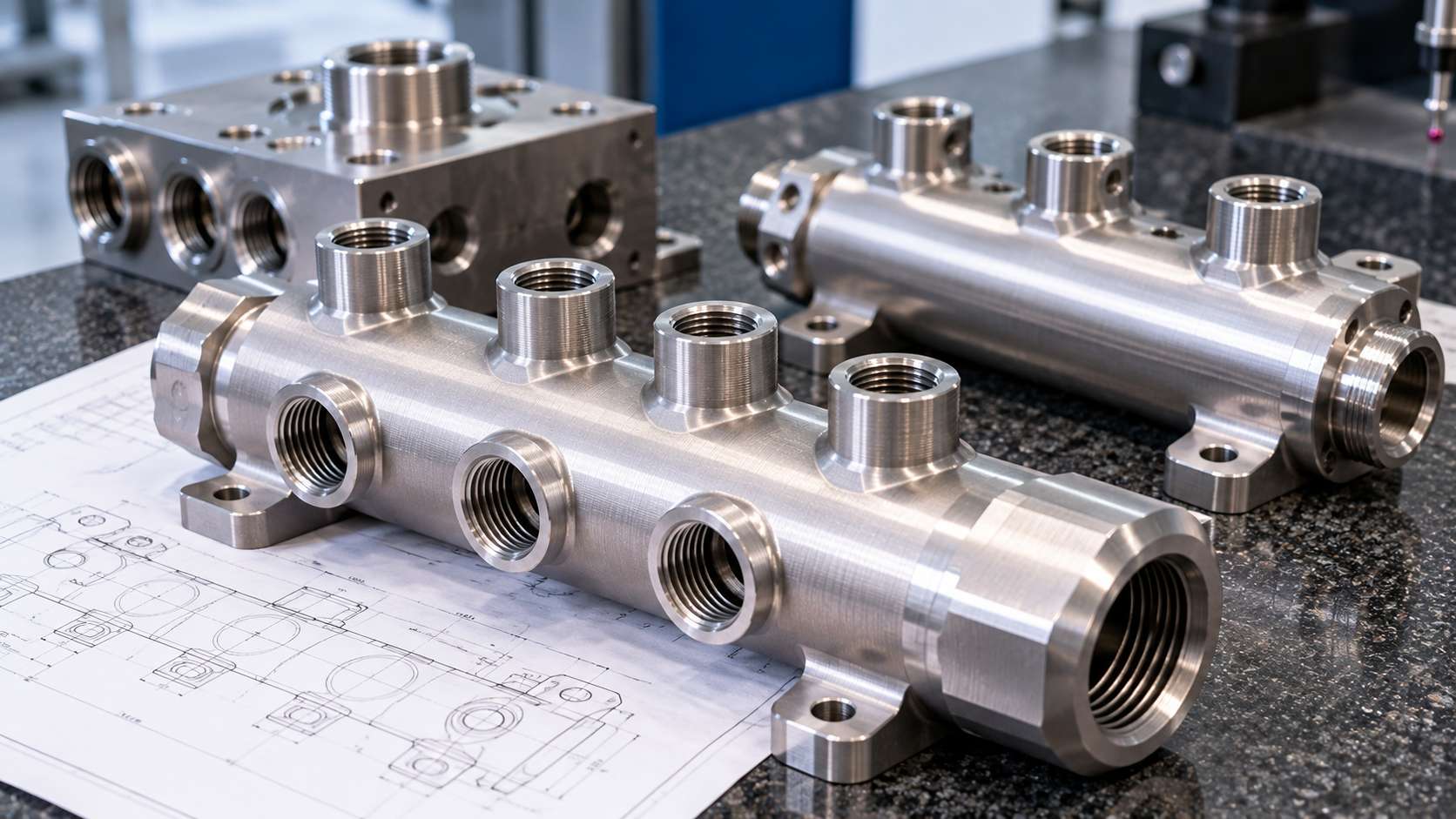
Typical Features of a Titanium Manifold
- Multiple inlet and outlet ports
- Internal drilled passages
- Internal or external threads
- Mounting holes
- Counterbores and locating features
- Sealing or mating surfaces
- Custom external profiles
Machining Intersecting Internal Passages
One of the main manufacturing challenges is producing internal passages that connect correctly inside the component. Hole depth, angle and position must follow the drawing so that the intended passages intersect while maintaining sufficient surrounding material.
Deep-hole machining also requires suitable chip evacuation and process control, particularly in titanium where heat and chips should be managed carefully.
Threaded Ports and Sealing Features
Manifold ports may include straight threads, drawing-specific connection threads or other customer-defined interfaces. Thread standard, pitch, depth and any associated sealing surface should be clearly specified.
The thread and surrounding geometry should be considered together because the mating component may locate against a shoulder, face or other defined surface.
Multi-Axis CNC Machining
A manifold can contain features on several faces. Depending on its complexity, 3-axis, 4-axis, 5-axis or multiple CNC setups can be used to reach the required surfaces and ports.
Reducing unnecessary repositioning can help maintain positional relationships between features and improve production consistency.
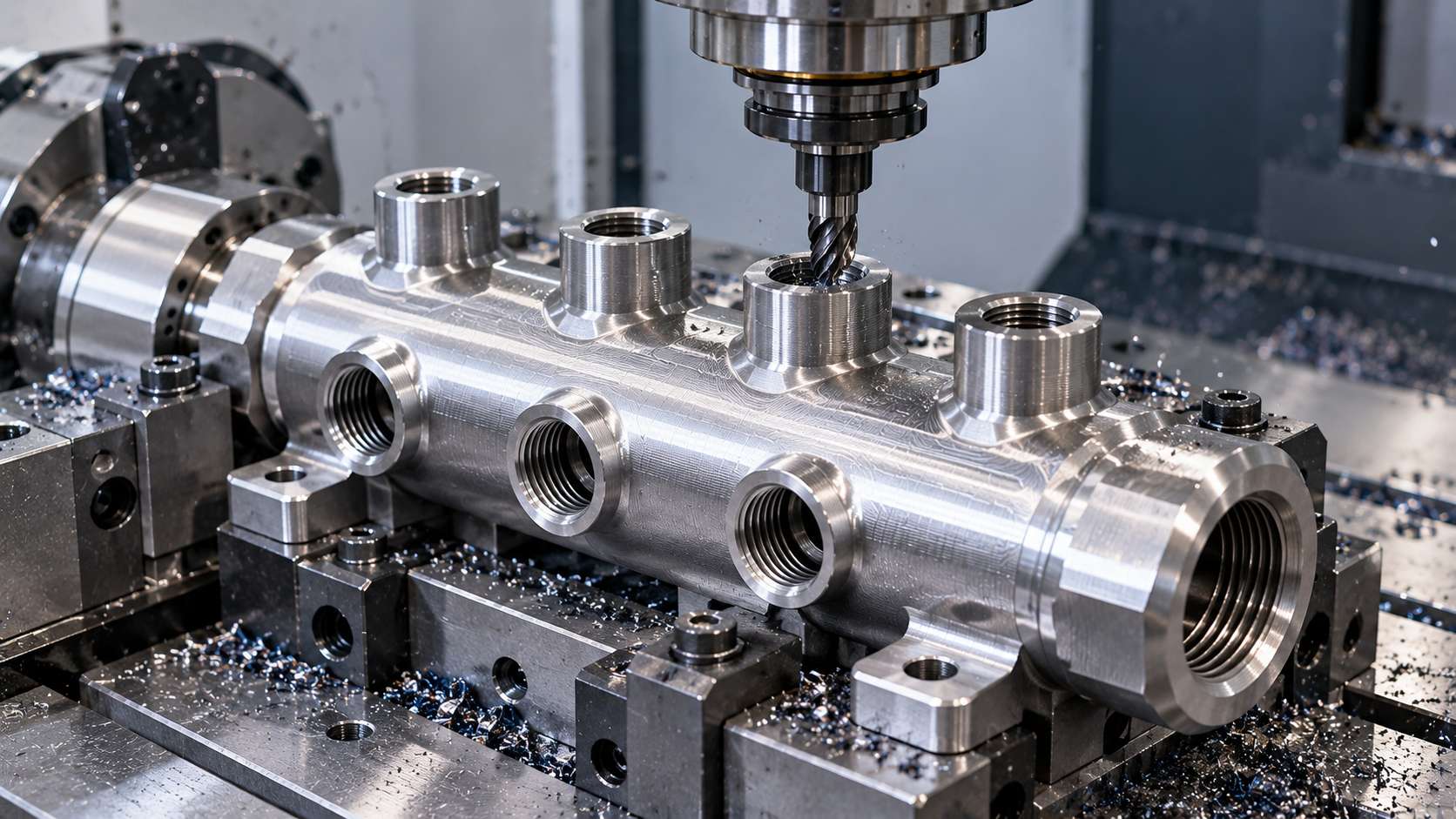
Deburring Internal Intersections
When drilled passages intersect, burrs can form inside the component. These locations may not be directly visible from the outside, making process planning and inspection particularly important.
Drawings should identify any special internal cleanliness, edge or finishing requirements relevant to the intended application.
Inspection Considerations
Typical dimensional checks can include port position, hole depth, thread quality, mounting dimensions and external geometry. Where required by the customer's specification, additional functional inspection can be planned for the finished component.
Information for Quotation
For custom manifold projects, provide the 2D drawing and 3D model, titanium grade, thread specifications, critical tolerances, surface requirements, inspection requirements and quantity. Section views showing internal passages are particularly useful during manufacturing review.
Custom Titanium Manifolds from Sunrise Industrial
Sunrise Industrial provides CNC turning, milling and multi-axis machining for drawing-based titanium components. Send your titanium manifold drawing or 3D model for manufacturing review and quotation.