
Titanium collars are compact machined components used for positioning, clamping, spacing or locating parts on shafts, tubes and other cylindrical assemblies. Although their geometry can appear simple, the functional requirements may involve a precision bore, controlled width, locating faces, threads and split-clamp features working together.
Sunrise Industrial manufactures custom titanium collars according to customer drawings and 3D models, using CNC turning, milling, drilling and thread machining for prototype, small-batch and repeat OEM production.
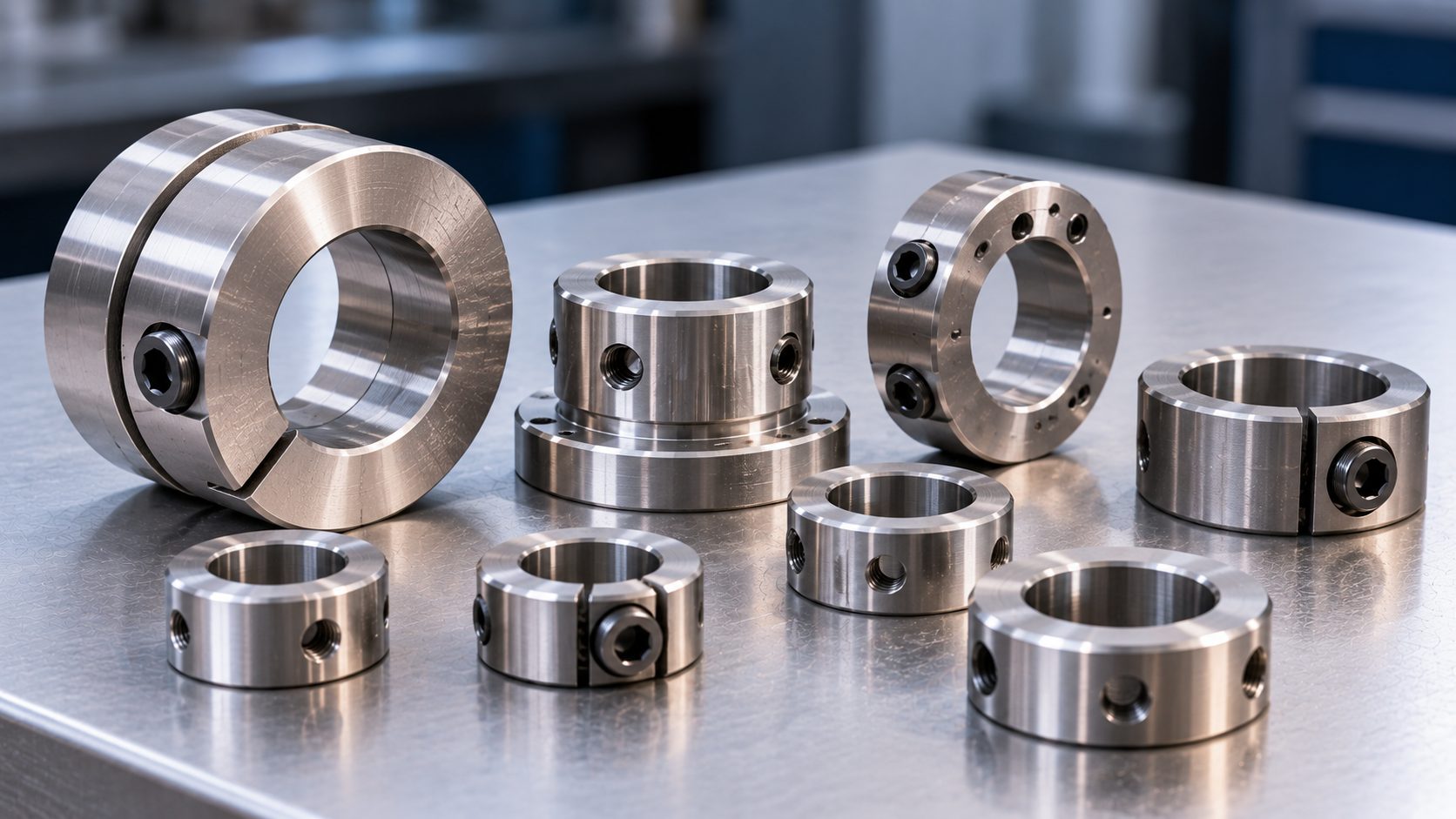
What Is a Titanium Collar?
A collar is generally installed around a shaft, tube or cylindrical feature to establish a position or provide a mechanical connection. Depending on the assembly, it may function as a stop, spacer, clamp or locating component.
Common custom configurations include:
- Plain round collars
- Set-screw shaft collars
- Split-clamp collars
- Threaded collars
- Shouldered collars
- Flanged collar designs
- Drawing-specific locating and mounting collars
The appropriate design depends on how the collar interfaces with the mating shaft or tube and how it is secured in the final assembly.
Precision Bore Machining
The internal bore is often the most important dimension on a titanium collar because it determines the relationship between the collar and its mating shaft or tube.
A clearance-fit collar and a precision locating collar do not require the same bore tolerance. For this reason, the drawing should specify the functional fit rather than applying unnecessarily tight tolerances to every dimension.
Depending on bore size, tolerance and surface requirements, machining can include drilling, boring, reaming or precision turning.
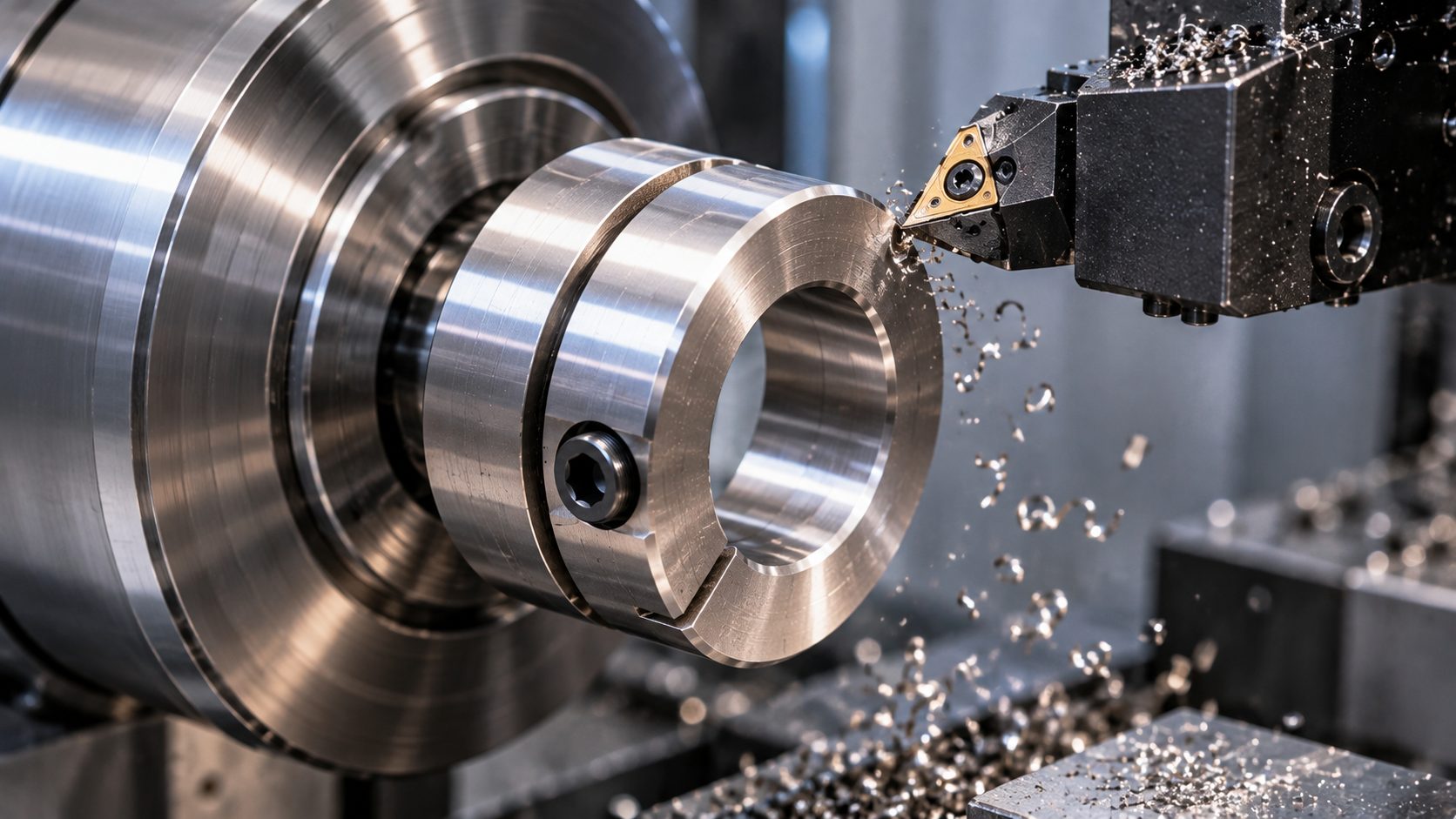
CNC Turning of Titanium Collars
Round collars are well suited to CNC turning. The process can establish the outside diameter, bore, overall width, shoulders, grooves and end faces from common references.
For titanium components, suitable cutting conditions and stable workholding are important for controlling heat, tool wear and surface quality. This becomes more significant when the collar has a relatively thin wall between its inside and outside diameters.
Additional milling and drilling operations can then be used for split features, transverse holes, flats and clamping screws.
Split-Clamp Titanium Collars
A split collar uses a machined opening and clamping screw to reduce the bore slightly around the mating component. Unlike a simple set-screw design, the clamping force can be distributed over a larger contact area.
Manufacturing a split collar requires more than cutting a slot into a finished ring. Bore size, slot width, screw position, threaded hole and surrounding wall thickness all influence the completed component.
The machining sequence should therefore be planned according to the customer's finished-part drawing and specified bore condition.
Set-Screw and Threaded Features
Set-screw collars typically include one or more radial threaded holes. Other custom collar designs may incorporate axial threads, mounting holes or additional connection features.
Thread size, pitch, depth and position should be clearly defined. Thread inspection and burr removal are particularly important where the threaded hole intersects the precision bore.
Width, Faces and Locating Accuracy
When a collar acts as an axial stop or spacer, its overall width and end faces become functional dimensions. Face parallelism and the relationship between the bore and locating surfaces may therefore matter more than the cosmetic appearance of the outside diameter.
Critical dimensions should be identified on the drawing so that machining and inspection effort can be focused on the features that actually affect assembly performance.
Titanium Material Options
Grade 5 titanium is commonly specified for CNC machined components where a combination of strength, low density and corrosion resistance is required. Other titanium grades can also be machined when specified by the customer.
Material selection should follow the engineering requirements of the complete assembly. For existing OEM parts, Sunrise Industrial manufactures according to the material grade defined on the approved drawing or purchase specification.
Inspection of Custom Titanium Collars
Typical inspection items may include:
- Internal bore diameter
- Outside diameter
- Overall width
- Shoulder dimensions
- Thread size and position
- Split width and clamping features
- Face and surface condition
Inspection requirements should correspond to the tolerances and functional features defined by the customer rather than applying the same measurement method to every collar design.
What to Include in a Titanium Collar RFQ
For an accurate manufacturing review, provide the 2D drawing or 3D model, titanium grade, bore tolerance, outside dimensions, thread specifications, surface requirements and required quantity.
If the collar must fit an existing shaft or tube, providing the mating diameter and required fit can also help clarify the functional requirement before production.
Custom Titanium Collars from Sunrise Industrial
Sunrise Industrial provides CNC turning and milling for custom titanium collars, spacers, sleeves, shafts and other drawing-based titanium components. Send your drawing, 3D model, material specification and quantity for manufacturing review and quotation.