
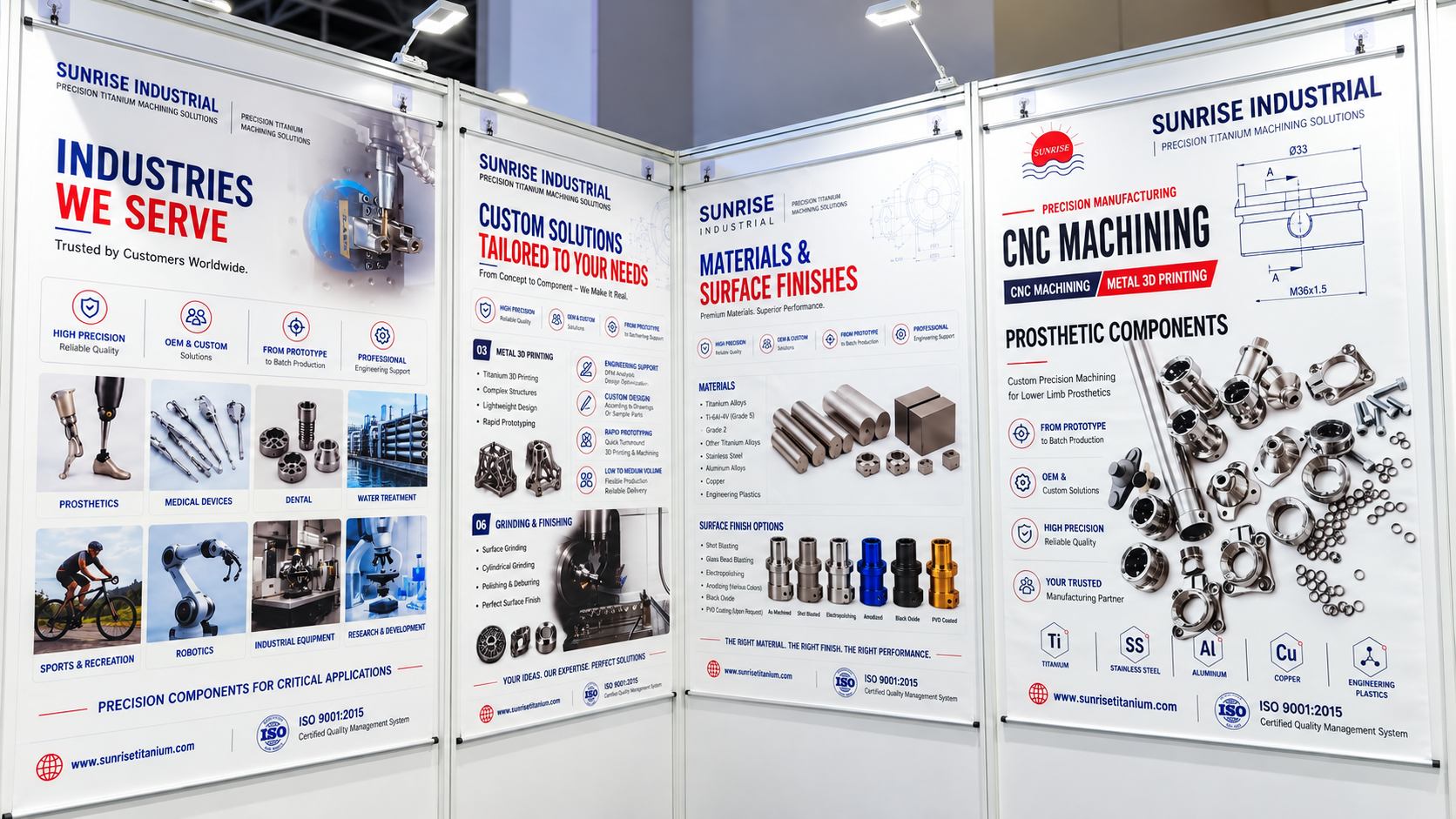
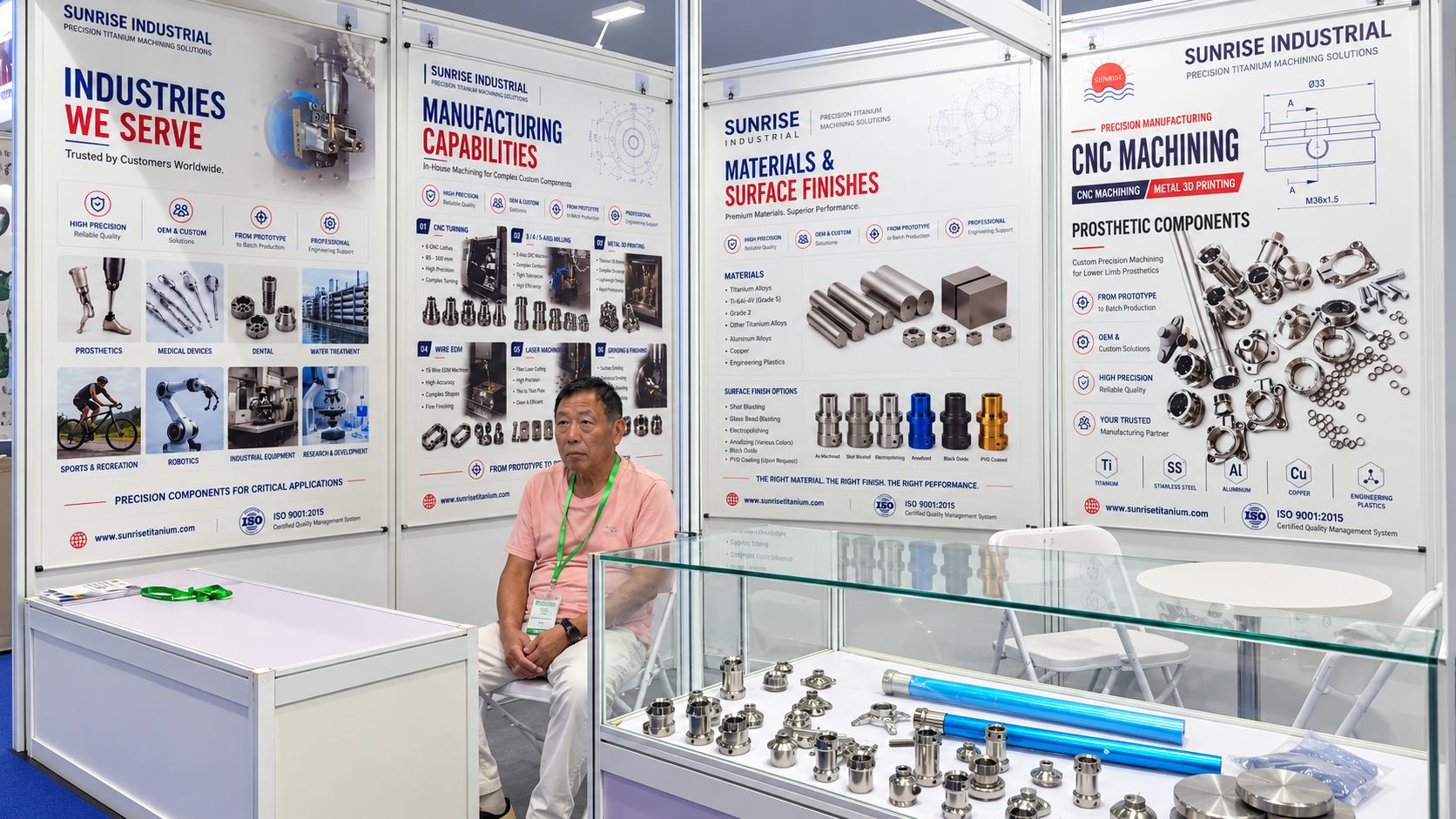
Sunrise Industrial recently participated in CR Expo Beijing 2026, presenting our precision manufacturing capabilities for custom prosthetic components, titanium CNC machined parts and other drawing-based OEM components.
For us, the exhibition was not only an opportunity to display finished products. It was also a chance to explain what Sunrise Industrial does best: turning customer drawings, 3D models and physical samples into manufacturable components through CNC machining, prototyping, 3D printing and related production processes.
More Than Standard Prosthetic Components
Many visitors first recognized Sunrise Industrial through our prosthetic adapters and modular connection components. These products include socket adapters, tube clamp adapters, tube adapters, pyramid adapters, receivers, double-ended adapters, sliding adapters and other lower-limb prosthetic components.
However, these products represent only one part of our manufacturing capability. Sunrise Industrial is fundamentally a CNC machining manufacturer. Our production is based on customer drawings, dimensions, samples and technical requirements rather than only on a fixed product catalogue.
Titanium CNC Machining Is One of Our Core Capabilities
Titanium has been an important material in Sunrise Industrial's manufacturing work for many years. We machine titanium components for prosthetic, industrial, dental, vacuum, coating and other precision applications.
Compared with many conventional metals, titanium requires more careful consideration of cutting parameters, tool condition, heat generation, workholding and machining sequence. These factors become even more important when a component contains thin walls, deep holes, multiple angled surfaces or tight dimensional relationships.
Custom Titanium Parts from Drawings and Samples
A large part of our work begins with a customer's PDF drawing, STEP model or existing physical sample. Instead of asking customers to adapt their design to one standard component, we review whether the required part can be produced efficiently and consistently.
Depending on geometry, production may involve CNC turning, 3-axis milling, 4-axis machining, 5-axis machining, turn-mill operations, wire cutting, grinding, laser processing and secondary surface treatment.
Typical Titanium Components We Can Machine
| Product Area | Typical Custom Components |
|---|---|
| Prosthetic Components | Pyramid adapters, receivers, tube clamps, socket adapters, pylons and custom connectors |
| Precision CNC Parts | Shafts, sleeves, flanges, connectors, threaded components and custom housings |
| Dental Applications | Titanium dental discs and drawing-based machined components |
| Coating and Vacuum Applications | Titanium sputtering targets, anodes, flanges and related components |
| Special OEM Parts | Low-volume prototypes, replacement components and customer-specific mechanical parts |
Prototype First, Production Later
Not every project should begin with hundreds or thousands of pieces. For a new component, it is often more practical to manufacture a small number of prototypes first and confirm dimensions, mating relationships, appearance and assembly before moving into repeat production.
This is especially useful for custom prosthetic components and other assemblies where several parts must work together. A dimensional change that appears small on a drawing can sometimes have a significant effect on the final assembly.
3D Printing for Design and Sample Evaluation
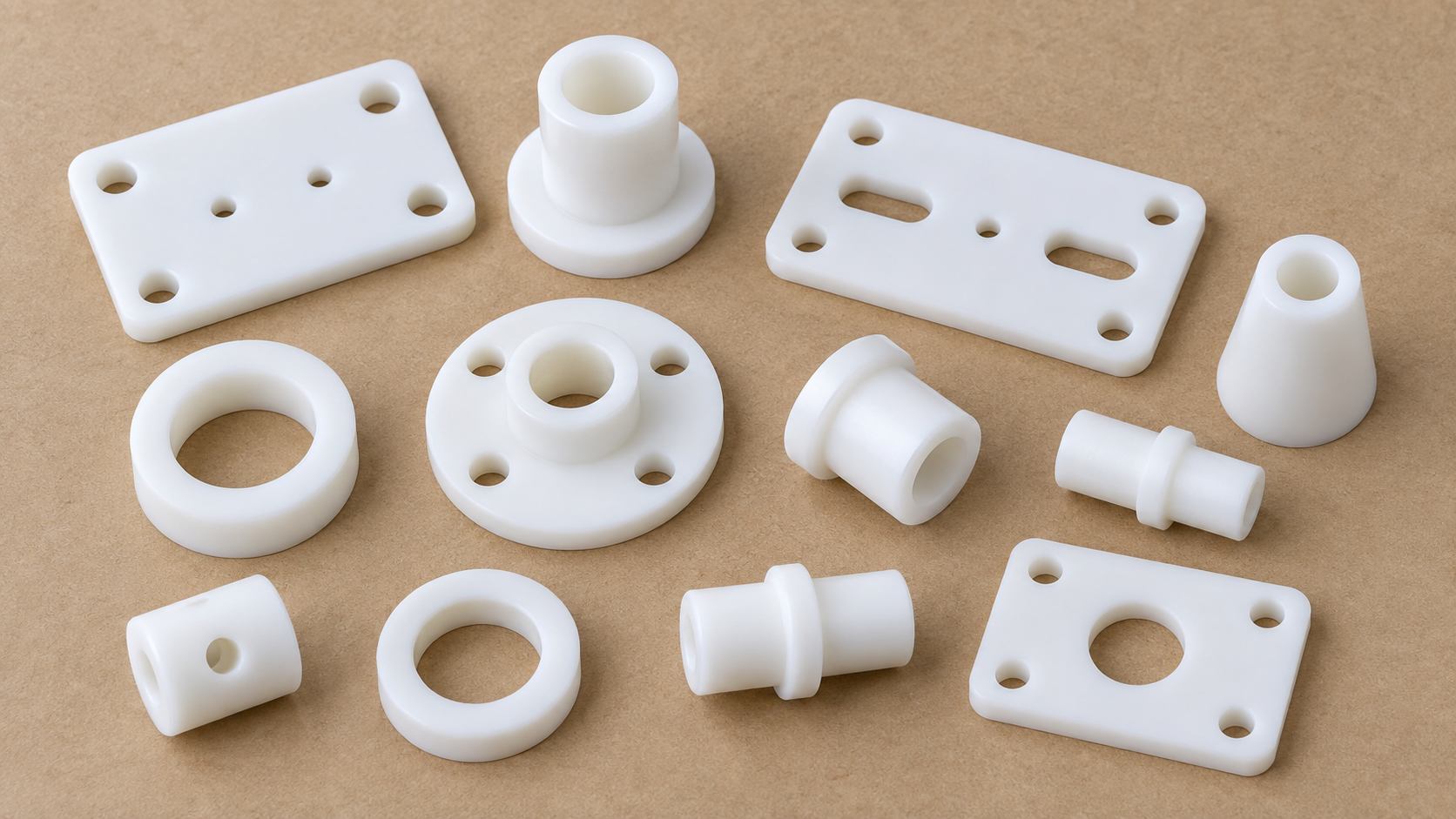
3D printing provides another useful option during product development. Before committing to CNC machining or other production methods, a printed sample can help customers review overall shape, dimensions, assembly relationships and appearance.
Different printing materials can be selected depending on the purpose of the sample. Resin can provide a relatively smooth surface and good visual detail, while nylon can offer better toughness for functional handling. The appropriate choice depends on whether the prototype is mainly intended for appearance review or functional evaluation.
3D Printing Does Not Replace CNC Machining
3D printing and CNC machining serve different purposes. A printed prototype is useful for quickly reviewing geometry and appearance, while the final metal component may still require CNC machining to achieve the required material, dimensional accuracy and surface condition.
For some development projects, using both processes can reduce unnecessary machining iterations. A design can first be checked through 3D printing and then transferred to CNC production after the main geometry has been confirmed.
Complex and Thin-Wall Components
Some of the enquiries we receive involve thin walls, deep cavities, curved surfaces or other geometries that are more difficult to manufacture than conventional turned parts. These designs require an early review of wall thickness, tool access, fixturing and possible deformation during processing.
Depending on the project, CNC machining, 3D printing or a combination of different processes may be considered. The objective is not to force one manufacturing method onto every design, but to select a practical route according to the component requirements.
Titanium, Stainless Steel and Aluminum
Although titanium is a major focus of Sunrise Industrial, we also machine stainless steel and aluminum components. This is useful for customers developing a family of related parts in different materials or comparing material options during prototype development.
Each material behaves differently during machining and finishing. Therefore, material selection should be determined by the customer's product design and engineering requirements rather than by geometry alone.
From One Sample to Repeat OEM Production
A new project may begin with only one physical sample or a small prototype order. Once the drawing and manufacturing method are confirmed, the same component can move into small-batch or repeat production.
For repeat projects, machining programs, fixtures, inspection methods and production records can be maintained and optimized. This helps improve consistency when the customer returns for future batches.
Quality Control for Custom Machined Parts
Custom production requires inspection according to the actual drawing rather than a generic product standard. Diameter, position, threads, hole size, profile, surface condition and mating features may all require different inspection methods.
Sunrise Industrial uses dimensional inspection equipment including CMM, optical inspection and conventional gauges according to component requirements. Critical threads, precision holes and mating interfaces can also receive additional checks when required by the project.
Why Exhibitions Are Useful for Custom Manufacturing Projects
For a custom machining company, an exhibition is different from displaying standard consumer products. The most useful conversations often begin when a visitor shows us a drawing, a sample or even a photo of a component and asks whether it can be manufactured.
These discussions allow us to understand the intended material, quantity, surface requirement and assembly condition before providing a manufacturing suggestion. In many cases, the real opportunity is not the product already displayed on the booth, but the next custom component that the customer needs to develop.
What to Send Us for a Custom Project
Useful RFQ Information
For a new CNC machining or prototype project, please send the 2D drawing, STEP model or physical sample when available, together with the required material, quantity, tolerance, surface finish and application information. For early-stage development, photos or preliminary dimensions can also help us begin a manufacturing review.
Custom Manufacturing from Sunrise Industrial
Sunrise Industrial is a precision CNC machining and custom component manufacturer with a strong focus on titanium. We support customers with prosthetic components, titanium CNC machined parts, dental discs, sputtering targets, fasteners and other drawing-based OEM components. Prototype development, 3D printing and multi-axis CNC machining can be combined according to individual project requirements.
Have a Custom Titanium or CNC Machining Project?
Send us your drawing, STEP file, sample or project information. We can review the component geometry, material, prototype method and CNC machining requirements before quotation.
Contact UsAbout Sunrise Industrial
Sunrise Industrial is an ISO 9001:2015 precision CNC machining and custom component manufacturer. Our manufacturing capabilities include CNC turning, 3-axis, 4-axis and 5-axis milling, turn-mill machining, wire cutting, laser processing, grinding and dimensional inspection for titanium, stainless steel, aluminum and other customer-specified components.